Category: Success
-
Why? Why? Why?
Why do so many people from all walks of life—all races, creeds and colors — continue to promote racism? Does ANYONE not know that the mere reference to skin color is racist?
Why do we often mention “Black owned business” and never “White owned” ones?
Why do some promote specifically “Black” organizations and not specifically “White” ones?
Why do Black Lives Matter without mention of ALL lives? Doesn’t anyone else matter?
If we’re trying to remove racism from our culture; why do we continue to use language that promotes or draws attention to it?
I believe that ALL LIVES will become equal (as far as skin color goes), when we stop linking our thinking to skin color and instead, focus on contribution, service, skill, producing something of value to all humanity.
-
When You Can’t Change the Situation
Change Your Response to It
I’m not always successful with this approach and you probably won’t be either, but I’ve found it to be a good place to start. Three things to do:
- Just be where you are. Let the present situation be what it is instead of what you think it should be.
- Do not regret the kindness and respect you have shown to the wrong people. Your behavior says everything about you, and their behavior says volumes about them. Carry on… with grace.
- Let go. Don’t overreact. You don’t have to join every fight. Most situations won’t make one iota of difference soon.
Think. Sit quietly with your situation. Resist the urge to respond in the same old way you always have.
I like to write about it in my journal, let it rest a couple of days and come back to it. Often mental/emotional space opens up for a new approach.
While you may not be responsible for your current situation, though often you are, you are responsible for your thinking, feeling, and action responses.
Which Comes First?
- Thought / Action—Action / Thought
- Thought / Feeling—Feeling / Thought
- Thought / Belief—Belief / Thought
Almost all “situations” contain thought triggers, or memories real or imagined, which produce a wide range of responses—emotional, physical, behavioral, etc.. Our awareness of these triggers and our habitual responses to them completely dictate the quality of our life… regardless of circumstance.
-
Faster
The Universe is expanding faster.
Moore’s Law says computer chip speeds and capabilities are getting faster—doubling every two years.
I can vouch for that and more. In my experience, as the years go by, time is definitely going by faster.
“Change is the essence and cadence of the universe,” as I remarked in a talk many years ago, way back in the 1960s. And Seth Godin presented some cogent thoughts about this in his newsletter today as he spoke about the speed of change.
It turns out that the biggest shift to our culture isn’t the changing speed of a computer chip. It’s what happens when we network humans together.
Adding more people to the internet has sped up science, politics and every element of culture and everything in our life. The echos happen faster; the learning is exponential, and connected communities heat and morph ever faster. I wonder what the internet 3.0 will bring.
Science used to be a solo endeavor. A monk with some pea plants could figure out genetics. Today, there are millions of people advancing the work of millions of people, with new updates coming all day long. The problems are dramatically more difficult, but the solutions are possible because we’ve multiplied the speed of change.
That’s why so many people are interested in writing and actually writing today. We live in electric and exciting times. One writer inspires and triggers thoughts, feelings, emotions, and motivations in another writer/reader and more and more energy is pouring into the universe of thought and ideas. This explosion of thought energy is thrusting humankind into a literally unimaginable future—at least unimaginable for me. It is endorphin overload to think about it. It’s going in all directions at once! Which lightning bolt do I hitch a ride on?
Ok, my wife, Lilyane, says slooow down… We must exercise some common sense. There needs to be some control. We can’t have all these crazy’s controlling the world. Responsible Citizens MUST THINK about what’s best and most responsible for the whole of humanity—the country—the planet, the world, the universe. So please…Think!
- big
- national, what’s best for America
- global, best for America AND the world
- personal, your heart, what you FEEL
- what you can do to make a life for all mankind better
-
A little Personal Pep Talk to Manage Overreaction
Maintaining calmness—not overreacting or taking things too personally — keeps your mind clear, your emotions peaceful, and your composure under control in otherwise uncontrollable situations. You’ve experienced this: calm composure is a human superpower. So ask yourself: “How can I respond from a place of clarity and strength today, rather than reacting in anger or frustration to the painful experiences I’m confronted with?”
Sit with that question for a moment.
Every time you’re tempted to react in the same old way, pause for a moment of breath meditation—in two, three, four, out two, three, four five—make space for a healthy change of state, for something new to enter…
Consciously redirect your focus by taking it away from something unchangeable that drags you down, and instead zero in on something small and actionable that moves you forward in the present moment.
Nothing is stopping you right now. Nothing is holding you back but your own thoughts and reactions to “how life is.”
You may not be responsible for everything that’s happened to you in the past, or everything that’s happening to you now, but you ARE responsible for undoing the counterproductive thinking and behavioral patterns these circumstances create.
Think better so you can ultimately live better.
No matter what happens, you can choose your response, which powerfully influences what happens next. Your greatest weapon against anxiety, negativity, and stress is your ability to pause, breathe, and chose one present response over another—to train your mind to make the best of what’s in front of you.
Life gets better when you get better at managing your better way of being.
-
Decision Making
The most practical decision-making is not making better choices, it’s learning to deal with uncertainty. The most common thing holding people back from the right answer is holding on to previous beliefs. Instead of instinctively rejecting new information, take in what comes your way through a thoughtful system of evaluating probabilities and then pivot.
-
Mental Garden
From As a Man Thinketh by James Allen
Man’s mind may be likened to a garden, which may be intelligently cultivated or allowed to run wild.
James AllenAct is the blossom of thought; and joy and suffering are its fruits; thus does a man garner in the sweet and bitter fruitage of his own husbandry.
James AllenSelf-control is strength; Right Thought is mastery; Calmness is power. Say unto your heart, “Peace. Be still!”
James Allen -
Success
The most important factors for #success are no longer how many hours you work, how much effort you exert, or where you are located. What matters now is what you know, how well you document and organize that knowledge, and your ability to share it with others.
Personal Knowledge Management has become an essential survival skill for everyone navigating the modern world.
-
80/20
Understanding the Pareto principle
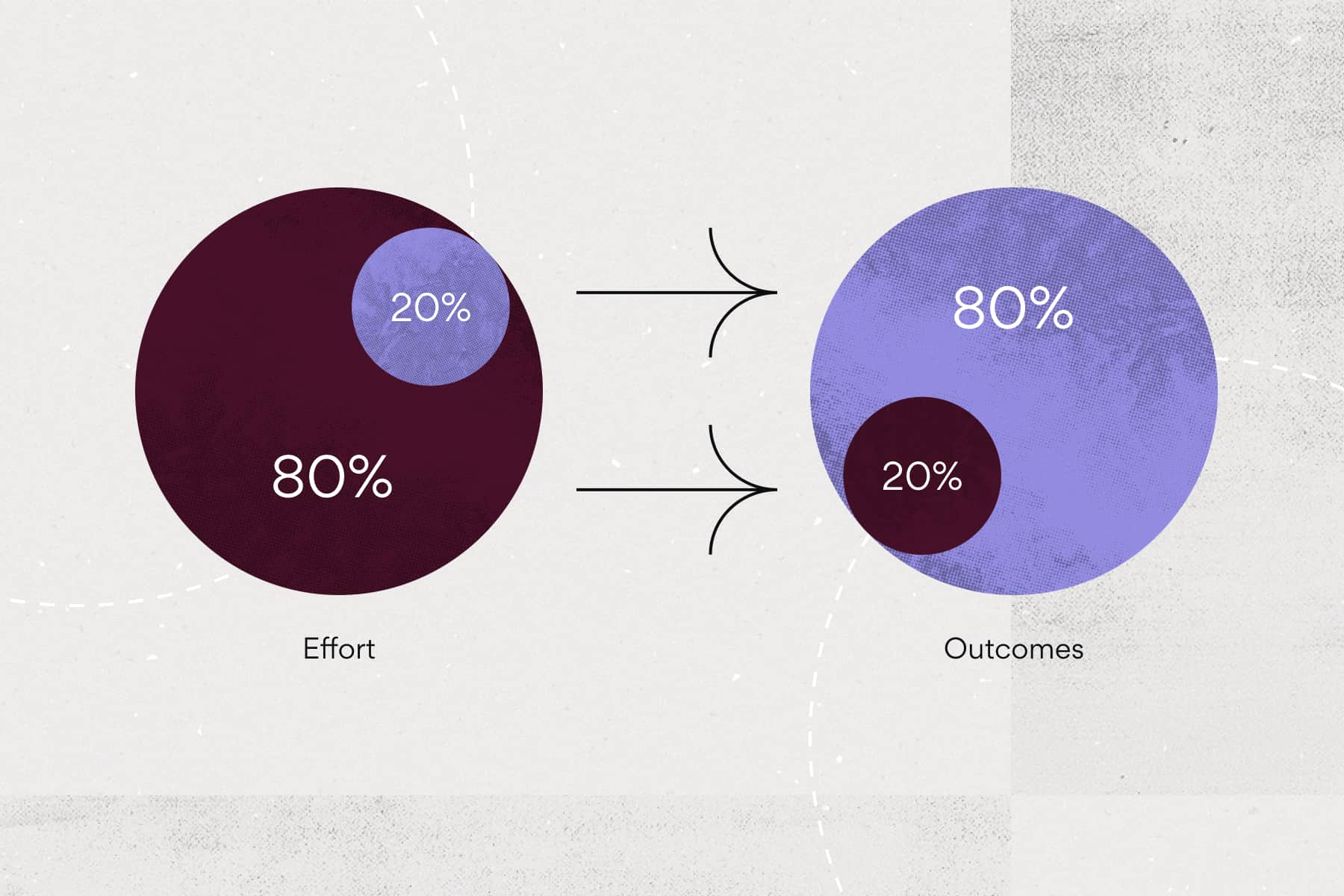
When you start your day, what’s the first thing you do? Most of us grab our caffeinated beverage of choice, check email, and prioritize tasks for the day. How do we identify what needs to get done first?
One common technique is called the Pareto principle, also known as the 80/20 rule. This technique can help determine and prioritize the highest-impact tasks, thereby increasing productivity throughout the day.
What is the Pareto principle?
The Pareto principle states that for many outcomes, roughly 80% of consequences come from 20% of causes. A small percentage of causes have an outsized effect. This concept is important to understand because it can help identify which initiatives to prioritize for the most impact.
Where does the Pareto principle come from?
This phenomenon also goes by a couple of different names:
- Pareto principle
- The 80/20 rule (most common)
The 80/20 rule is not a formal mathematical equation. It is a rule of thumb, not a law of nature. It’s observed in economics, business, time management, and even sports.
General examples of the Pareto principle:
- 20% of a plant contains 80% of the fruit
- 80% of a company’s profits come from 20% of customers
- 20% of players result in 80% of points scored
How to use the 80/20 rule
The 80/20 rule applies to almost every industry. The Pareto principle is commonly used in business and economics. This is because the 80/20 rule is helpful in determining where to focus efforts towards maximizing output.
The basis of the Pareto principle states that 80% of results come from 20% of actions. Work that can be segmented into smaller parts allows the Pareto principle to help identify what part of that work is the most influential.
Here are a few examples of how to use the tool in practice.
Productivity
Use the 80/20 rule to prioritize the tasks needing to get done during the day.
Out of the entire task list, completing 20% of those tasks will result in 80% of the impact on that day. So, in order to get the most accomplished, identify which tasks have the most impact and focus on those for the day.
Decision making
The Pareto principle can help you to make the best decisions during the problem-solving process. When there are many causes to one problem, the Pareto principle can help prioritize solutions. Here are a few steps to how this works:
- Identify the problems within this decision-making process.
- Identify the causes of these problems.
- Categorize problems into similar groups. This can help determine if one solution can resolve multiple issues.
- Assign a value to each of these problems based on its impact on the project. The value can be as simple as a number between 1-10, or actual monetary value to show the importance.
- Develop a plan to focus on the top 20% of the problems that impact the project. One solution can resolve multiple problems. Based on the values assigned to each problem, calculate which ones are in the top 20%. Once you’ve identified the main problem, develop a plan to create a solution that can cause 80% of the results using problem-solving strategies.
Example of how to use the 80/20 rule for decision making:
Imagine an ecommerce company. 100 of the most recent customer service complaints come from the fact that customers are receiving damaged products. 80% of refunds given were for damaged products.
Improving packaging to protect products during shipping resolves the issue with customers receiving damaged products.
Quality control
The Pareto analysis and the Pareto chart are key tools used within the Six Sigma quality control methodology.
In the Six Sigma methodology, using a Pareto chart can help visualize your data to identify how to prioritize actions. Six Sigma’s main goal is to reduce the amount of variation in a process with the goal of increasing the amount of production. Pareto charts are common in Six Sigma methodology because they help to identify what most of the variations are in a process.
Advantages of using the Pareto principle
The biggest advantage of using the Pareto principle is to create the maximum amount of impact with the least amount of work. This facilitates the best use of time, focus, and resources.
The 80/20 rule improves metrics by prioritizing initiatives in the right order.
Other benefits of using the Pareto principle:
- Clear priorities
- Increased daily productivity
- Ability to portion work into manageable segments
- More focused strategy