Category: Purpose

  • Make Sure The Mountain is Worth Climbing

    Many things in life are hard. We value hard work and extra effort in our culture. BUT, just because you are giving a great effort does not mean you are working toward a great result. How are you making sure that mountain is really worth climbing?

    I’m entering the 9th decade of life on this planet and if I have any regrets about the way I’ve chosen to live out that time, it would be that most of my effort has been wasted on unimportant, unnecessary, frivolous endeavors with little or no ultimate value to myself or anyone else.

    Flat Squirrel

    I’ve always been curious about many things, and possessed with an adventurous spirit. I’ve travelled the world. I’ve supported life, (often not well), with a new job on average, every 2 to 4 years. That’s about how long it takes to burn out or figure out “that mountain ain’t the one I want to climb”. Been many places. Done many things. Jack of all trades, master of none. While I’ve never formally completed higher education certification, I have taken and still take hundreds of courses and read thousands of books. I’m a lifelong learner. I have MID (Multiple Interest Disorder). I still haven’t found THE mountain I REALLY want to climb. I thought I had several times. In the end, they haven’t panned out. Time is running out. While I do enjoy security and a nice lifestyle, I still long for an all-consuming project that will produce something of significance for the world. I love this life. It could be better. I’d like to make it better for those who follow.

    Those “flat squirrels” I mentioned are the many past versions of me chasing this, that, or the other “new” trend, “opportunity”, “purpose”, or “calling”. Those squirrels are flat because of poor planning and indecision.

    Learning to THINK for YOURSELF and filter all the well intended or otherwise, BS that parents, neighbors, friends, society, culture, academia, and snake-oil salespeople throw at you is the most important mountain anyone can climb.

    I think I’ll write a book—maybe a series. I’ve been a wanna-be writer for a very long time.

  • Faster

    The Universe is expanding faster.

    Moore’s Law says computer chip speeds and capabilities are getting faster—doubling every two years.

    I can vouch for that and more. In my experience, as the years go by, time is definitely going by faster.

    “Change is the essence and cadence of the universe,” as I remarked in a talk many years ago, way back in the 1960s. And Seth Godin presented some cogent thoughts about this in his newsletter today as he spoke about the speed of change.

    It turns out that the biggest shift to our culture isn’t the changing speed of a computer chip. It’s what happens when we network humans together.

    Adding more people to the internet has sped up science, politics and every element of culture and everything in our life. The echos happen faster; the learning is exponential, and connected communities heat and morph ever faster. I wonder what the internet 3.0 will bring.

    Science used to be a solo endeavor. A monk with some pea plants could figure out genetics. Today, there are millions of people advancing the work of millions of people, with new updates coming all day long. The problems are dramatically more difficult, but the solutions are possible because we’ve multiplied the speed of change.

    That’s why so many people are interested in writing and actually writing today. We live in electric and exciting times. One writer inspires and triggers thoughts, feelings, emotions, and motivations in another writer/reader and more and more energy is pouring into the universe of thought and ideas. This explosion of thought energy is thrusting humankind into a literally unimaginable future—at least unimaginable for me. It is endorphin overload to think about it. It’s going in all directions at once! Which lightning bolt do I hitch a ride on?

    Ok, my wife, Lilyane, says slooow down… We must exercise some common sense. There needs to be some control. We can’t have all these crazy’s controlling the world. Responsible Citizens MUST THINK about what’s best and most responsible for the whole of humanity—the country—the planet, the world, the universe. So please…Think!

    • big
    • national, what’s best for America
    • global, best for America AND the world
    • personal, your heart, what you FEEL
    • what you can do to make a life for all mankind better

  • Preserving Consciousness

    /https://www.youtube.com/watch?v=YRvf00NooN8

    The Most Exciting Video I’ve Ever Seen!

    It’s more than an hour, but very interesting and thought provoking.

  • Operations

    Repetitive Routines, Habits, Work Flows

    Philosophy is “why”. Yes, I’m always asking that. Strategy is “how”; another one of my favorite thought modes. Tactics are “what”… but Operations, (as in a manufacturing workflow) are more than “who” or “where” or “when”. Tactics are “who”, “what”, “when” and then some. Tactics are an applied deep understanding of philosophy and strategy applied to a situation. Operations Management, Life Management, Business Management all require a coherent “System” of well thought out repeatable processes, habits, rituals, flows, steps, represented by the Management Cycle… Planning, Implementing, Reviewing, analyzing and constantly improving with each cycle.

  • 80/20

    Understanding the Pareto principle

    Understanding the Pareto principle (The 80/20 rule) article banner image

    When you start your day, what’s the first thing you do? Most of us grab our caffeinated beverage of choice, check email, and prioritize tasks for the day. How do we identify what needs to get done first?

    One common technique is called the Pareto principle, also known as the 80/20 rule. This technique can help determine and prioritize the highest-impact tasks, thereby increasing productivity throughout the day.

    What is the Pareto principle?

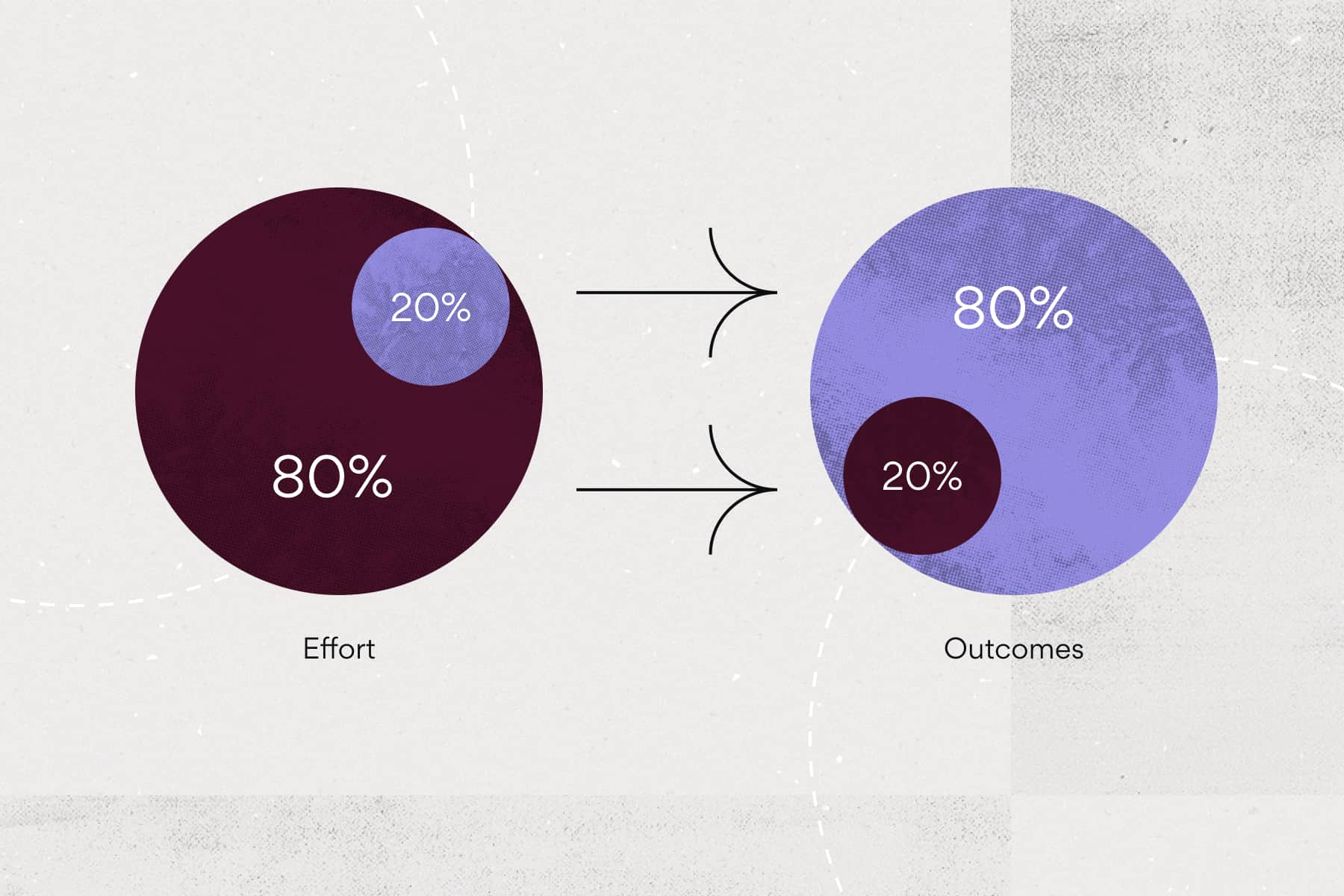
    The Pareto principle states that for many outcomes, roughly 80% of consequences come from 20% of causes. A small percentage of causes have an outsized effect. This concept is important to understand because it can help identify which initiatives to prioritize for the most impact.

    Where does the Pareto principle come from?

    This phenomenon also goes by a couple of different names:

    • Pareto principle
    • The 80/20 rule (most common)

    The 80/20 rule is not a formal mathematical equation. It is a rule of thumb, not a law of nature. It’s observed in economics, business, time management, and even sports.

    General examples of the Pareto principle:

    • 20% of a plant contains 80% of the fruit
    • 80% of a company’s profits come from 20% of customers
    • 20% of players result in 80% of points scored

    How to use the 80/20 rule

    The 80/20 rule applies to almost every industry. The Pareto principle is commonly used in business and economics. This is because the 80/20 rule is helpful in determining where to focus efforts towards maximizing output. 

    The basis of the Pareto principle states that 80% of results come from 20% of actions. Work that can be segmented into smaller parts allows the Pareto principle to help identify what part of that work is the most influential.

    Here are a few examples of how to use the tool in practice.

    Productivity

    Use the 80/20 rule to prioritize the tasks needing to get done during the day. 

    Out of the entire task list, completing 20% of those tasks will result in 80% of the impact on that day. So, in order to get the most accomplished, identify which tasks have the most impact and focus on those for the day.

    Decision making

    The Pareto principle can help you to make the best decisions during the problem-solving process. When there are many causes to one problem, the Pareto principle can help prioritize solutions. Here are a few steps to how this works:

    1. Identify the problems within this decision-making process.
    2. Identify the causes of these problems.
    3. Categorize problems into similar groups. This can help determine if one solution can resolve multiple issues. 
    4. Assign a value to each of these problems based on its impact on the project. The value can be as simple as a number between 1-10, or actual monetary value to show the importance.
    5. Develop a plan to focus on the top 20% of the problems that impact the project. One solution can resolve multiple problems. Based on the values assigned to each problem, calculate which ones are in the top 20%. Once you’ve identified the main problem, develop a plan to create a solution that can cause 80% of the results using problem-solving strategies.

    Example of how to use the 80/20 rule for decision making: 

    Imagine an ecommerce company. 100 of the most recent customer service complaints come from the fact that customers are receiving damaged products. 80% of refunds given were for damaged products.

    Improving packaging to protect products during shipping resolves the issue with customers receiving damaged products.

    Quality control

    The Pareto analysis and the Pareto chart are key tools used within the Six Sigma quality control methodology. 

    In the Six Sigma methodology, using a Pareto chart can help visualize your data to identify how to prioritize actions. Six Sigma’s main goal is to reduce the amount of variation in a process with the goal of increasing the amount of production. Pareto charts are common in Six Sigma methodology because they help to identify what most of the variations are in a process. 

    Advantages of using the Pareto principle

    The biggest advantage of using the Pareto principle is to create the maximum amount of impact with the least amount of work. This facilitates the best use of time, focus, and resources.

    The 80/20 rule improves metrics by prioritizing initiatives in the right order.

    Other benefits of using the Pareto principle:

    • Clear priorities
    • Increased daily productivity
    • Ability to portion work into manageable segments
    • More focused strategy
  • In Lieu of One Life Purpose

    Instead of Your Life’s Purpose:

    A meditation on meaning that explores the non-linear ways life progresses beyond a simple conception of a personal mission.

    A common misperception many of us have regarding a meaningful life is that we have a special purpose in life—and that once we find it, all our confusion ends. We’re saved from the happenstance and absurdity of our lives.

    While some people may discover a mission that does this, most of us will not—at least not in a way that makes for a good “Hero’s Journey” story.

    Our infatuation with stories portraying “the hero’s journey” select for meaning stories that scratch a certain human itch. They project a narrative simplicity backwards onto lives full of false leads, crises, and dead ends. They gloss over long periods of despair, the noise of randomness, the elements of chance, and personal and moral failings to tell the story of someone special who carried out a special mission. We have been told these stories all our lives, so we have deeply internalized them. “If only I could find my purpose!” And there’s actually truth to this. It’s me. It’s the story of my life.

    There is an alternate truth to my life as well. It’s premised on the idea that life is full of randomness punctuated by sudden moments—crises and opportunities—with vast potential for meaning making, when our skills and virtues shine.

    Rather than struggle to discover a purpose or vocation, we become people who can recognize and exploit opportunities to create meaning as they arise—resourceful and audacious people who live adventurous lives.

    This approach means not waiting to find your story arc, but recognizing that there are stories that pop up which you can opt into if you recognize them and have the right skills and virtues. It is about being prepared for the call to adventure, and cultivating the ability to recognize it, rather than believing we can direct our lives from the perspective of some knowable, ultimate mission (purpose).

    Where does meaning come from?

    Your class, your caste, your country, sect, your name or your tribe, there’s people always dying trying to keep them alive.”

    Bright Eyes

    The meaning I’m talking about is the kind that relieves a certain despair—the despair that comes from knowing that we must suffer and die and wondering if anything can be worthwhile in the face of these facts.

    Some sources of meaning seem to be:

    • participation in something larger that will survive ourselves—a nation, a family, a faith
    • creativity and flow states—bringing something genuinely novel into the world. When all our talents, including our deeply held and latent ones are used, this is more meaningful than when we are schlepping along.
    • love—when our sense of wellbeing has loci outside of ourselves—friends, family, and lovers
    • pro-social utility, or good works—creating a surplus of security and resources that others can use to survive and pursue their own sense of meaning
    • an internal sense of coherence, wholeness, and dignity

    Some people may find their sense of meaning is satisfied entirely from one of the above sources. Most of us, however, develop a portfolio of meaning—we have multiple sources of it in our lives, and cannot in fact derive it from only one source any more than we can be healthy on a diet of bread and water.

    What is the linear approach?

    The linear approach imagines that the meaning of our lives can be reduced to a mission, like the kind that fixes saints, heroes and social reformers in the historical imagination. “Created a vaccine.” “Expelled an occupier.” “Founded a religious order.” Of course, these accomplishments may admit multiple achievements or adventures—but are usually reduced to one overarching narrative.

    This imagines that if we found a sufficiently noble cause to devote our lives to—one to which our talents were suited and appropriate—we would be free to the suffering that is caused by the knowledge of death (and the possibility that it might strike at any time).

    Of course, there are people who have been personally fulfilled from devoting their life to a cause. For many, though, it does not work—our noble causes run into moral complexities on the ground, or are mirages based on a distorted vision of the world. They may leave us open to manipulation by careerist sociopaths, who know that we will chase any projected image that offers a shred of meaning, like a cat chasing a laser dot.

    What is the non-linear approach?

    The non-linear approach is different—rather than trying to discover a particular arc path and follow it to its conclusion, it recognizes that there will be many moments and opportunities to create meaning that arise in our life. The idea is not that we will take part in one story that can be easily wrapped up by our biographers—but that there are many adventures and quests that we can pursue. Rather than the attitude of the saint who is given a mission by God, it takes the attitude of the swashbuckling adventurer who goes out to seek his fortune.

    Instead of imagining yourself as the hero of a Hollywood movie, imagine yourself as a hearty ancestor that you might brag about when drunk: the one who rode bareback, founded a town, fought a grizzly bear, raised 10 kids, saved her son’s life by drinking the governor under the table, and went to the frontier to stay one step ahead of the hangman and her gambling debtors.

    This approach to the problem of meaning recognizes that, rather than trying to discern a mission, it is better to become a certain person—a person who can act on and recognize opportunities to make meaning when they are seen.

    Opportunism and Power Laws

    One advantage of the non-linear approach is that it does not demand that we devote every spare moment of our time to fulfilling some pre-ordained goal. It is more adaptive to the realities of power laws—of moments of high payoff or high risk—than of the day-to-day grind of accrual. If our lives are rich in opportunities for meaning, rather than defined by a singular narrative arc, we can act decisively at particularly important moments rather than imagining that every moment is equally meaningful. There are profound asymmetries and power laws at play in the pursuit of meaning—a split second decision might be the most important one you make; years of lounging around in cafes and on beaches might pay off more than years of hard work—if it results in one excellent idea.

    Trying to treat all of our time as equally meaningful and fungible because you can devote it to The Cause leads to absurdities. Consider this example of someone debating whether he should tell someone their car trunk is open:

    I hold open doors for little old ladies. I can’t actually remember the last time this happened literally (though I’m sure it has, in the last year or so). But within the last month, say, I was out on a walk and discovered a station wagon parked in a driveway with its trunk completely open, giving full access to the car’s interior. I looked in to see if there were packages being taken out, but this was not so. I looked around to see if anyone was doing anything with the car. And finally, I went up to the house and knocked, then rang the bell. And yes, the trunk had been accidentally left open.

    Under other circumstances, this would be a simple act of altruism, which might signify genuine concern for another’s welfare, or fear of guild for inaction, or a desire to signal trustworthiness to oneself or others, or finding altruism pleasurable. I think that these are all perfectly legitimate motives, by the way; I might give bonus points for the first, but I wouldn’t deduct any penalty points for the others. Just so long as people get helped.

    But in my case, since I already work in the nonprofit sector, the further question arises whether I could have better employed the same sixty seconds in a more specialized way, to bring greater benefit to others. That is: can I really defend this as the best use of my time, given the other things I claim to believe?

    Time is not fungible—a moment of opportunity, or a chance to respond appropriately to a crisis, might not occur again. Our creative powers do not flow smoothly and evenly like water from the tap to the drain, but chaotically like a babbling brook going from the mountains to the ocean—with different shoals, rapids, pools, and speeds along the way. Believing that our efforts must flow from smooth, even and continuous effort rather than coming in uneven bursts leads to unnecessary guilt and anxiety about “wasted” time.

    The need to regulate our time into a continuous flow is the result of the agricultural and industrial revolutions. It is something we do to serve economies of scale in which we are interchangeable parts. But meaning, creative power and fortune arrive on their own schedules, and imagining that you can or should devote every waking moment to something is absurd.

    When there is only one possible source of meaning in our life, we adapt ourselves for efficiency: our goal might be to win souls for Jesus, or stop Skynet. We make ourselves machine-like. When the world is full of possibilities for meaning, we adapt ourselves for resiliency, flexibility and maneuverability. Resiliency, because we must survive long enough to take advantage of these latent sources of meaning, and flexibility, and maneuverability in order to act quickly and appropriately when they come up. Instead of looking for a cause to devote your life to, you might try to become someone who is useful and level-headed in a crisis, who is well connected and makes friends easily, or who regularly has good ideas.

    Interests and Projects

    Giving up on a life’s purpose does not mean there are not areas which are more fruitful to pursue than others. When you are interested in something, this suggests a fertile area. If nothing else, interests represent low-hanging fruits of reward-to-effort payoff: when you are pursuing an interest, rather than an obligation, you can use the energy you would otherwise need to browbeat yourself into actually doing things. Therefore it seems so easy to read about whatever your personal obsession is – astrology, kabbalah, entomology – rather than whatever the marketplace or superego tells you should pursue – tax law, Bible study, a programming language (these are examples only many people have interests or disinterests in these subjects!) Like the God of the Old Testament, we will love whom we will love, and we will be fascinated by that which fascinates us.

    If we have an interest, there is a challenge to make it meaningful – with some things, this will be easier than others, because our culture that tells us how to do has given a script to us so. More obscure interests represent more of a challenge – but also easy opportunities. A quick glance at the internet will reveal artists who are using new media to create works of brilliance in unexpected places. There are Twitter threads made by anonymous writers which contain more insight than most published academic papers, and memes which capture the human condition better than most works found in art galleries. Your heroes become what they were by breaking genuinely new ground – doing things that those before them thought were unthinkable. To be like them, you must surf the void at the frontiers of meaning – and discover meaning where no one else thought it would be, transforming harsh barrens into lush gardens.

    The linear approach of finding a mission and dedicating one’s life to it – is typically best for those who have an overpowering, obsessive interest in something. If you are like this, chances are this article is not for you, and you are not grasping at meaning but hoping to read more about the Thing which so consumes your thoughts. If this is the case, your vocation has already chosen you.

    Selfishness, Love, and Integrity

    Because several loci of meaning – pro-social utility, love, and self transcendence – involve escapes from our localized self interest, we can feel guilt or a dearth of meaning when we act selfishly, when we cannot love as often or as deeply as we should, or when our interests do not lead down paths which generate surpluses and resources for others.

    Sometimes it is, in fact, necessary to put others first – you may have to take time out from your career or hobby to care for a child or an ailing parent, or to help your community or nation deal with some crisis. You may realize that you are spending too much time in the workshop and not enough time with your children. But taken too far, this thinking can also produce crippled, resentful individuals who give back only a fraction of what they would have if they were flourishing. Your children need food, clothes and education, and they need your love and guidance – but they also need to see you happy and engaged with life.

    Most of us have probably met some version of the pinched and crabby moralist – one who dedicated his or her life to some cause and did not get the spiritual payoff they thought they would, and are now resentful and controlling. There was a time when this was me. Thankfully, that period is part of my past.

    Instead of selflessness, strive for integrity. When you create, it should be things you think are good – that honestly portray your inner and outer world as best you are able. When you are honestly pursuing your own values and vision – and not subordinating them – you are more likely to generate meaning than if you are navigating a maze of compromises with some goal in mind. Especially if these compromises are dictated to you by a nagging superego that torments you with an image of moral heroism which you can never live up to.

    This requires faith and willingness to trust your values and intuitions rather than the well-worn stories dictated to you by culture. Recognize that the heroes whose lives inspired you did what they did, mostly by going out into the unknown and doing what others thought was impossible. This is not, incidentally, a guarantee that if you do so you will succeed – for the world to be a meaningful one, there must be uncertainty and risk.

    Meta-ethics and Meaning

    This approach to meaning – becoming a certain kind of person who can act appropriately in response to opportunities for meaning making – lends itself well to a particular school of meta-ethics, which is virtue ethics. Deontology, (a study of duty and obligations) represents the ethics of duty: the floor beneath which we must not sink, if we are to co-operate with others to pursue the goods of survival and flourishing. Consequentialism is the ethics of power and emergency, when there are clearly defined stakes which must be traded off against one another. In its utilitarian version, if flounders, precisely because a definition of “the good” requires more legibility than is typically available: of both our own values and the results of our actions in a real-world environment.

    The non-linear approach to meaning is about becoming the person who will, given a chance, act effectively to realize their values in this world, even if those values are not articulable except as a felt sense of meaning. It requires us to become developed along multiple axes of development: capable of risking it all in a dangerous, uncertain and beautiful world full of hazard and opportunity.
  • Learning How to Think

    Learning how to think really means learning how to exercise some control over how and what you think. It means being aware enough to choose what you pay attention to and to choose how you construct meaning from experience. Exercising this kind of choice will put you miles ahead in life.

  • Learning

    This is a good way to becoming the best you can be. What that is is up to you.

  • You PLAY Music

    You Play the Piano

    Alan Watts

                                                 English Spanish Gujarati Hindi                                              

    The existence, the physical universe is basically playful. There is no necessity for it whatsoever. It isn’t going anywhere. That is to say, it doesn’t have some destination that it ought to arrive at. 

    But it is best understood by analogy with music, because music, as an art form, is essentially playful. We say, “You play the piano.” You don’t work the piano.

    Why? Music differs from, say, travel. When you travel, you are trying to get somewhere. In music, though, one doesn’t make the end of the composition the point of the composition. If that were so, the best conductors would be those who played fastest. And there would be composers who only wrote finales. People would go to a concert just to hear one crackling chord… because that’s the end!

    Same way with dancing. You don’t aim at a particular spot in the room because that’s where you will arrive. The whole point of the dancing is the dance.

    But we don’t see that as something brought by our education into our conduct. We have a system of schooling which gives a completely different impression. It’s all graded and what we do is put the child into the corridor of this grade system with a kind of, “Come on kitty, kitty.” And you go to kindergarten and that’s a great thing because when you finish, you get into first grade. Then, “Come on” first grade leads to second grade and so on. And then you get out of grade school and you got high school. It’s revving up, the thing is coming, then you’re going to go to college… Then you’ve got graduate school, and when you’re through with graduate school, you go out to join the world.

    Then you get into some racket where you’re selling insurance. And they’ve got that quota to make, and you’re gonna make that. And all the time that thing is coming—It’s coming, it’s coming, that great thing. The success you’re working for.

    Then you wake up one day about 40 years old and you say, “My God, I’ve arrived. I’m there.” And you don’t feel very different from what you’ve always felt.

    Look at the people who live to retire; to put those savings away. And then when they’re 65, they don’t have any energy left. They’re more or less impotent. And they rot in some old peoples home, or senior citizens’ community. Because we simply cheated ourselves the whole way down the line.

    Because we thought of life by analogy with a journey, with a pilgrimage, which had a serious purpose at that end, and the thing was to get to that thing at that end. Success, or whatever it is, or maybe heaven after you’re dead.

    But we missed the point the whole way along.

    It was a musical thing, and you were supposed to sing or to dance while the music was being played.

    by Alan Watts, a British philosopher, writer, and speaker, best known as an interpreter and populariser of Eastern philosophy for a Western audience.