“You can’t wait until life isn’t hard anymore, before you decide to be happy.”
Jane Marczewski
As I opened my email this morning, the following from Stephen Guise reached out and touched me. So I’m sharing it with you as he shared it with me.
Before yesterday, I didn’t know who Nightbirde (Jane Marczewski) was. She is best known for being a singer who performed on America’s Got Talent, where she got the coveted “Golden Buzzer” from Simon Cowell. Jane tragically passed away from cancer at only 31 years old on Feb 19, 2022. After seeing Terry Crews post about her on Facebook, I looked her up. I was blown away by what I found. First of all, Jane had an amazing voice (link below). But she also had a gift with words and wisdom beyond her years. I think every human being can connect with something profound she said after her performance on America’s Got Talent. Here’s the context for her quote: Jane was diagnosed with breast cancer in 2017. It went into remission but came back in 2021, the year she debuted on America’s Got Talent. Jane, as you can see in her performance, was incredibly talented, but that’s not even what makes this story special. What makes this special is who Jane decided to be, which was revealed when she said one of the best quotes I’ve ever heard. After her performance on AGT, there was a moment of silence from a stunned crowd. When the judges began to speak of her performance, there was praise all around for her talent and how she turned her pain into art. When Simon Cowell began to speak about the positivity and authenticity she showed after what she’d been through, he got choked up and had to pause for a moment. And in that moment, she said this: “You can’t wait until life isn’t hard anymore, before you decide to be happy.”~ Jane Marczewski This quote hit me like a freight train, as the last few months have been among the hardest in my life. It’s incredible wisdom, isn’t it? You get the impression that she discovered this truth in a dark place, and that she changed the moment she realized it. Life is hard for most people most of the time. Don’t wait for life to get easy before you decide to enjoy it. Jane didn’t wait, and not only did she make the best of a very difficult hand dealt to her, her choice has already inspired millions of people as a result. I wanted to share this quote with you, and also inform you about the life of this incredible person who deserves to be remembered. I’m thankful I came across Terry Crews’ post, and so I wanted to pass this along. I will always remember you and what you said, Jane Marczewski, or NightBirde. My sincerest condolences to Jane’s family and friends.Watch Jane’s performance on America’s Got Talent here on YouTube.
How To Be Resilient: 5 Steps To Success When Life Gets Hard
by Eric Barker
***
Before we commence with the festivities, I wanted to thank everyone for helping my first book become a Wall Street Journal bestseller. To check it out, click here.
***
We always hear one thing about stress: it’s bad. I haven’t checked recently but I think that’s in the Constitution. Fortunately, stress is not that simple.
Researchers asked 30,000 adults how much stress they felt in the past year—and whether they thought stress was a negative. Eight years later, the scientists circled back. Yup, you guessed it—the high stress people were 43% more likely to have died…
But only if they believed stress was bad for their health. Let that sink in for a second. (Yes, we are holding a masterclass in WTF.)
So what about the people in that study who didn’t think stress was a negative?
People who reported high levels of stress but who did not view their stress as harmful were not more likely to die. In fact, they had the lowest risk of death of anyone in the study, even lower than those who reported experiencing very little stress. The researchers concluded that it wasn’t stress alone that was killing people. It was the combination of stress and the belief that stress is harmful.
And this isn’t some one-off weirdo study. If you specifically study people who have a positive vision of stress, you find they’re healthier, happier, and more productive.
Crum’s research shows that people who believe stress is enhancing are less depressed and more satisfied with their lives than those who believe stress is harmful. They have more energy and fewer health problems. They’re happier and more productive at work.
A heckler from the back of the room: “Oh yeah? Well, what about PTSD?”
PTSD is terrible. No dispute. But let’s talk about urine for a second. (Gross, I know, but I guarantee this is the only urine story you’re going to hear today, so bear with me.) Can you predict PTSD based on stress hormone levels immediately after a traumatic incident? Well, somebody checked.
Researchers had people who had just survived a major car accident pee in a cup. One month later, they checked in with them. The result? Patients who did not go on to develop PTSD had higher levels of adrenaline and cortisol immediately after the incident. More stress equaled less PTSD.
Study after study shows people—everyone from middle school students to Army Rangers — who have bigger surges of adrenaline and cortisol perform better under pressure. You know what doesn’t help? Staying calm.
Despite most people’s belief that some adrenaline improves performance, but too much impairs performance, the evidence suggests otherwise. When it comes to performing under pressure, being stressed is better than being relaxed.
And it’s not all about performance either. People who experience more stress say their lives are more meaningful.
In fact, every measure of stress that the researchers asked about predicted a greater sense of meaning in life… In contrast, the researchers reported that among individuals who appeared to be the most unhappy, experiencing high levels of shame and anger and low levels of joy, “there was a notable lack of stress.”
What the heck? Then why do we always hear that stress is terrible? Well, the whole idea started in 1936 with an endocrinologist names Hans Selye. His initial experiments did show stress was bad. But with more research, he changed his tune. Later, he would go on to actually recommend good stress as an antidote to bad stress, saying, “There is always stress, so the only point is to make sure that it is useful to yourself and useful to others.”
Turns out stress is a lot more nuanced than we’ve been led to believe. Handled properly, it can make you smarter and more successful. It can make life meaningful. It can even make you more compassionate and kind. But the difference between good stress and bad stress lies in our mindset. How we perceive and interpret those physiological changes in our body. With the right mindset, stress is your friend.
So what do we need to do—other than a product recall on our stress-is-always-bad beliefs? For those answers, we’ll turn to Stanford University’s Kelly McGonigal. Her eye-opening book is The Upside of Stress.
Ready to be more resilient? Let’s get to it…
I’m So Stressed… And That’s Awesome
First, a definition: “Stress is what arises when something you care about is at stake.” You don’t stress much about stuff that you don’t perceive as important.
But those hormones (like adrenaline and cortisol) are, by themselves, emotionally neutral amplifiers of your physiology. They amp you up, but whether that’s a positive (excitement) or bad (anxious) is dependent on your mindset.
The three most common mindsets are: threat, challenge, or tend-and-befriend. When we’re scared or feel overwhelmed, those hormones produce a threat response. That’s bad. But when our mindset is more positive, those hormones are rocket fuel.
… a challenge response increases self-confidence, motivates action, and helps you learn from experience; while a tend-and-befriend response increases courage, motivates caregiving, and strengthens your social relationships.
Pretty much everything you’ve heard about stress and heart attacks or other awful things is only related to the threat response. When you have a challenge response, stress actually makes you healthier and more effective.
In fact, the tendency to have a challenge response, rather than a threat response, is associated with superior aging, cardiovascular health, and brain health… During business negotiations, a challenge response leads to more effective sharing and withholding of information, as well as smarter decision-making. Students with a challenge response score higher on exams, and athletes perform better in competitions. Surgeons show better focus and fine motor skills… Importantly, none of these studies showed that performance was enhanced by the absence of a stress response; it was enhanced by the presence of a challenge response.
Best part? We can control how we respond. With a simple mindset shift, research shows you can turn a threat response into a challenge or tend-and-befriend response. You can turn anxiously, freaking out into “eye of the tiger.”
(To learn more about how you can lead a successful life, check out my bestselling book here.)
Alright, a stressful situation hits. What’s the first step? It’s the exact opposite of what you usually tell yourself…
Don’t Calm Down
You’re giving a presentation in front of your boss and all the senior executives. Your job is on the line. Heart is pounding. Hands are trembling.
Is it better to try to calm yourself down or to feel excited? When surveyed, 91% of people thought it was best to calm down. But Alison Wood Brooks of Harvard Business School decided to put that answer to the test.
Turns out people who told themselves to “be excited” felt more positive and more confident. And when judged by a panel, they objectively performed better, coming across as more competent.
Fighting your physiology is hard. The hormones are there. Telling them, “Shoo! Go away! Not now!” doesn’t work very well. Don’t resist the energy. Embrace it.
(To learn how to make emotionally intelligent friendships, click here.)
Okay, we’re not calming down. What’s the next thing to keep in mind?
Remind Yourself That Stress Is Good
To measure the effects of extreme tension, psychologists use something called the “Social Stress Test.” I’m not sure who came up with it, but I personally believe this person is the biggest sadist who has ever lived.
The first part is public speaking, something most people fear. But the people you’re speaking in front of are confederates—they’re in on it. And they have been instructed to look bored and angry as you give your talk. To yawn, roll their eyes and never ever smile. As if that wasn’t unpleasant enough, it’s followed by a timed math quiz. (Now I know what hell looks like.) The “Social Stress Test” has been shown to elevate stress hormone levels by 400%.
Before this study, half the subjects are told that stress is a positive, shifting them to a challenge mindset. The other half is told to just try to ignore the stress. Wanna guess what the results were for the first group? Correct answer wins a Red Lobster gift certificate…
They showed greater confidence and engagement, and less anxiety, shame, and avoidance. Objectively, they performed better. Afterward, they were less distracted by thoughts of fear and failure.
Now some people might say: “Yeah, that’s fine in general — but what about for people who have a clinical anxiety disorder? This could kill them.”
Here’s the thing: in that study, half the subjects did have social anxiety disorder. And the “stress is good” intervention made their results indistinguishable from people without a clinical condition. Everyone experiences heart pounding when things get tense. It’s how we interpret it that makes the difference.
The first step is to acknowledge stress when you experience it. Simply allow yourself to notice the stress, including how it affects your body. The second step is to welcome the stress by recognizing that it’s a response to something you care about. Can you connect to the positive motivation behind the stress? What is at stake here, and why does it matter to you? The third step is to make use of the energy that stress gives you, instead of wasting that energy trying to manage your stress. What can you do right now that reflects your goals and values?
(To learn how to raise emotionally intelligent kids, click here.)
But what if it doesn’t work? What if you can’t convince yourself that the trembling hands are a positive?
That’s okay. We just need to address something deeper…
Think Of Your Resources
Any time you face a difficult situation, a little stress accountant in the back of your head is running the numbers to come up with an answer to the question: “Can I handle this?” He tabulates your skills and preparation, compares it to the perceived difficulty of the situation and decides if his little Excel spreadsheet says you’re in the red or in the black.
If you believe that the demands of the situation exceed your resources, you will have a threat response. But if you believe you have the resources to succeed, you will have a challenge response.
How you think about your ability to do well in the situation makes the difference between stress-as-debilitating versus stress as Captain-America-Super-Soldier-Serum. If you get a big bill in the mail and your bank account is empty, you’re scared. If you have Bezos bucks, you chuckle. It’s all about how you see your resources.
So think of your strengths. The help you can get from friends. The times you’ve faced a similar challenge and performed well. And then think about that new resource you just learned about…
Your stress response. It’s a good thing—if you see it that way.
If you think stress is bad, your little accountant puts it in the “debits” column. If you think stress is good, he puts it in the “credits” column. When you perceive the heart pounding as something that’s dragging you down, you can be competent and fail. When you see it as a helper to be utilized, you just gained another resource.
And this is also the best way to help others. When they’re tense and you tell them to “calm down”, you’re implying that stress is bad. That they don’t have the resources and can’t handle it. Wrong message.
Studies show that when people are told, “You’re the kind of person whose performance improves under pressure,” their actual performance improves by 33 percent.
(To learn the 4 rituals that will make you happy all the time, click here.)
Okay, but what if you’re not the hard-charging, competitive, “challenge response” kinda person? Maybe you’re more of a mild soul who likes chamomile tea and Kenny G. Not a problem.
A positive perception of stress still helps. We just need to channel it differently…
Think of Your “Bigger-Than-Self” Goals
Remember, a “challenge response” isn’t the only positive stress mindset. We also have “tend-and-befriend.” Thinking about the need to help others in times of stress increases courage and motivation.
So when stress bears down, think about your “Bigger-than-self goals.” How what you need to accomplish affects the lives of those you love. Studies show this mindset eliminates the threat response and increases performance, even in tense situations like job interviews.
Participants who had reflected on their bigger-than-self goals showed more signs of affiliation with the interviewers, such as smiling, making eye contact, and unconsciously mimicking the interviewers’ body language—all behaviors shown to increase rapport and strengthen social connection. Further, raters preferred what these participants had to say, rating their answers as more inspiring than the responses of participants who had not contemplated their values.
Asking the boss for a raise? Don’t think about that fancy new caviar spoon you’ve had your eye on. Think about how that money is going to make life better for your kids or your partner.
Or maybe you’re writing a blog post on the benefits of stress, but you just don’t feel motivated and want to take a nap. Think about how that post could improve the lives of the people who read your stuff. A study currently in progress at the University of Barker (n=1), seems like it might confirm the effectiveness of this technique.
(To learn how to stop being lazy and get more done, click here.)
Okay, we’ve covered a lot. Let’s round it all up and answer the biggest question – why the heck does life gotta be so stressful in the first place?
Sum Up
Here’s how to be more resilient:
Stress is bad when we see it as bad: We can respond to stress with a threat, a challenge or a “tend-and-befriend” mindset. And with a little work, you can alter which one you have.
Don’t calm down. Do not try to relax. Embrace the excitement. It’s not a crisis—it’s a strong cup of coffee.
Remind yourself stress is a helper: Whatever you’re dealing with, it’s not as bad as the wall-to-wall nightmare of “The Social Stress Test.” Remind yourself those physiological changes are actually a nitrous system for your brain. Change “I’m so stressed!” to “Ahh, I’m so stressed.”
Think about your resources: Remember your strengths, the help you can get from friends, and your prior successes. And don’t forget the biggest resource of all: those stress hormones. If you welcome them, they’ll come to your aid.
Focus on “bigger-than-self” goals: Never get between a momma bear and her cubs. When we remind ourselves of how what we’re doing can help others, “awful” stress becomes a courage and motivation booster.
When you survey people about how they cope with stress, 82% say they draw strength from past stressful experiences. And when researchers interview the folks who thrive under stress, you hear something similar: they see it as an opportunity to grow. They choose meaning over avoiding discomfort. They embrace the challenge.
That’s inspiring, but why the heck does life need to be so challenging all the time? Good lord, enough already.
In my totally unscientific but anecdotally unassailable opinion, the best answer to this comes from the great thinker Alan Watts. He proposed a little thought experiment…
Imagine you could choose your dreams at night. And due to how weird and distorted time can be in a dream, you could live an entire amazing life in one night’s dream. So in 8 hours of sleep, you could have a 75-year life that fulfilled all your wishes. Each night, you would lay down and experience a life of pure pleasure. Sounds awesome, right? And it would be…
But after a while, inevitably, you’d get a bit bored. But you can choose your dreams. So you’d make a dream life where you had a little less control. A surprise or two, just to keep it exciting. Movies are more fun when the hero has a close call. When it doesn’t seem as easy. They still win in the end, but the tension makes it exciting.
And so night after night, you’d add some more difficulty to make the pleasure that much sweeter at the end. A little extra challenge to the dream each time, until finally…
“You would dream the dream of living the life that you are actually living today.”
You’re not overwhelmed by life. It’s just enough stress to make the dream a challenge. Enough to make the rewards that much sweeter in the end. It’s all how you perceive it.
I would love to think this post changed your life. But if you did find it helpful, it will actually work by a very different route. It won’t change your life…
It will confirm the wonder and joy of your life as it already is.
Join over 345,000 readers. Get a free weekly update via email here.
When you start your day, what’s the first thing you do? Most of us grab our caffeinated beverage of choice, check email, and prioritize tasks for the day. How do we identify what needs to get done first?
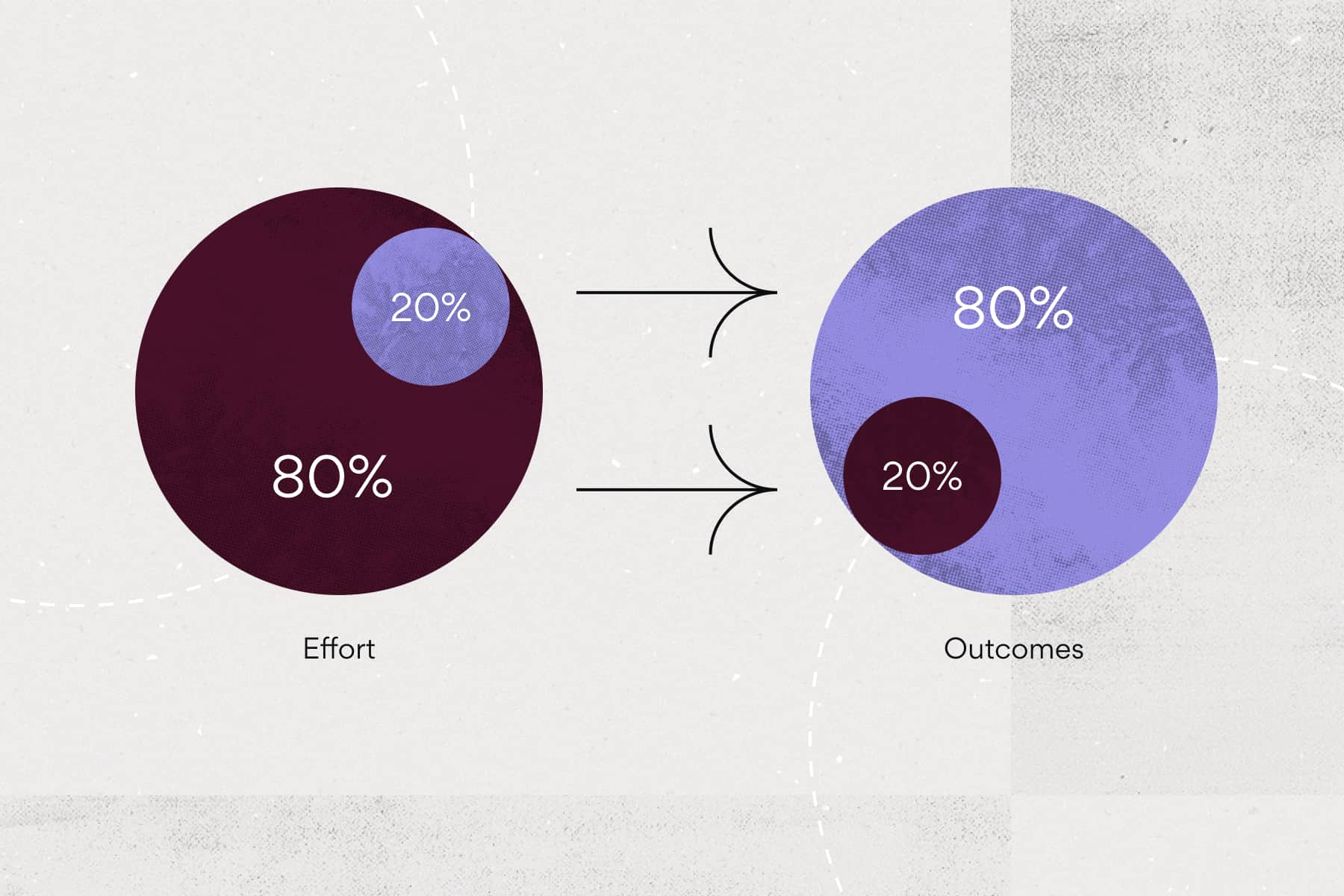
One common technique is called the Pareto principle, also known as the 80/20 rule. This technique can help determine and prioritize the highest-impact tasks, thereby increasing productivity throughout the day.
What is the Pareto principle?
The Pareto principle states that for many outcomes, roughly 80% of consequences come from 20% of causes. A small percentage of causes have an outsized effect. This concept is important to understand because it can help identify which initiatives to prioritize for the most impact.
Where does the Pareto principle come from?
This phenomenon also goes by a couple of different names:
Pareto principle
The 80/20 rule (most common)
The 80/20 rule is not a formal mathematical equation. It is a rule of thumb, not a law of nature. It’s observed in economics, business, time management, and even sports.
General examples of the Pareto principle:
20% of a plant contains 80% of the fruit
80% of a company’s profits come from 20% of customers
20% of players result in 80% of points scored
How to use the 80/20 rule
The 80/20 rule applies to almost every industry. The Pareto principle is commonly used in business and economics. This is because the 80/20 rule is helpful in determining where to focus efforts towards maximizing output.
The basis of the Pareto principle states that 80% of results come from 20% of actions. Work that can be segmented into smaller parts allows the Pareto principle to help identify what part of that work is the most influential.
Here are a few examples of how to use the tool in practice.
Productivity
Use the 80/20 rule to prioritize the tasks needing to get done during the day.
Out of the entire task list, completing 20% of those tasks will result in 80% of the impact on that day. So, in order to get the most accomplished, identify which tasks have the most impact and focus on those for the day.
Decision making
The Pareto principle can help you to make the best decisions during the problem-solving process. When there are many causes to one problem, the Pareto principle can help prioritize solutions. Here are a few steps to how this works:
Identify the problems within this decision-making process.
Identify the causes of these problems.
Categorize problems into similar groups. This can help determine if one solution can resolve multiple issues.
Assign a value to each of these problems based on its impact on the project. The value can be as simple as a number between 1-10, or actual monetary value to show the importance.
Develop a plan to focus on the top 20% of the problems that impact the project. One solution can resolve multiple problems. Based on the values assigned to each problem, calculate which ones are in the top 20%. Once you’ve identified the main problem, develop a plan to create a solution that can cause 80% of the results using problem-solving strategies.
Example of how to use the 80/20 rule for decision making:
Imagine an ecommerce company. 100 of the most recent customer service complaints come from the fact that customers are receiving damaged products. 80% of refunds given were for damaged products.
Improving packaging to protect products during shipping resolves the issue with customers receiving damaged products.
Quality control
The Pareto analysis and the Pareto chart are key tools used within the Six Sigma quality control methodology.
In the Six Sigma methodology, using a Pareto chart can help visualize your data to identify how to prioritize actions. Six Sigma’s main goal is to reduce the amount of variation in a process with the goal of increasing the amount of production. Pareto charts are common in Six Sigma methodology because they help to identify what most of the variations are in a process.
Advantages of using the Pareto principle
The biggest advantage of using the Pareto principle is to create the maximum amount of impact with the least amount of work. This facilitates the best use of time, focus, and resources.
The 80/20 rule improves metrics by prioritizing initiatives in the right order.
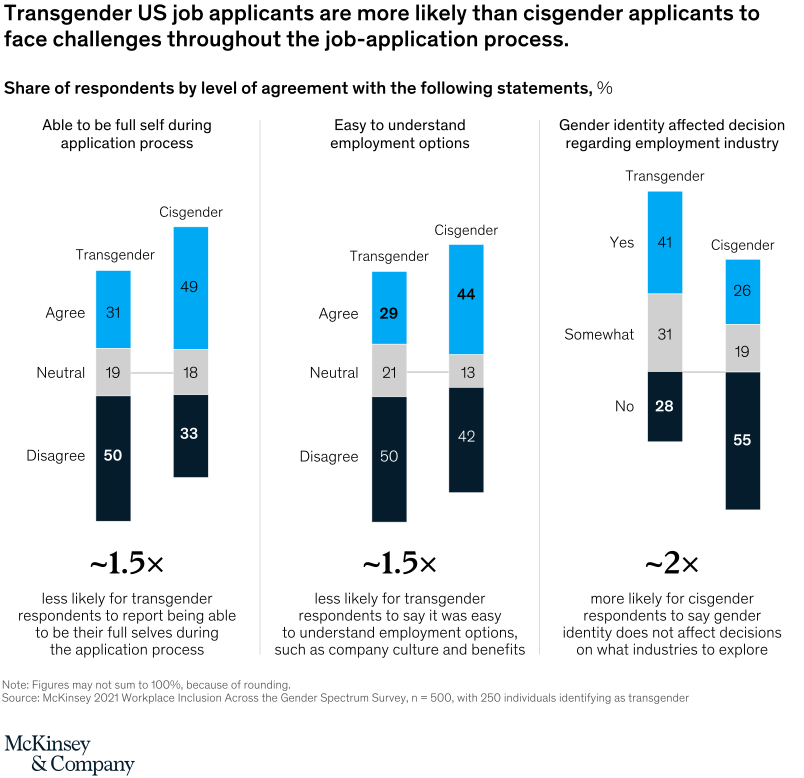
January 17, 2022 In a culture that still largely views gender on binary terms, transgender people in America face unique challenges in the job-application process. Half of transgender respondents to a recent McKinsey survey indicated they couldn’t be their full selves when applying for jobs. Only 33 percent of cisgender applicants indicated the same.
I don’t understand why diverse outliers, whether their diversity is skin color, actual qualification for the job, sexual orientation, or image, (supporting the ’employer’s brand’), expect—no, demand that employers and society at large welcome them with open arms. They seem to want the world-at-large to “include” them, but they don’t want to “include” or respect the majority culture in which they live.
Personally, I respect everyone’s right to choose for themselves. But please Y’all, don’t try to force or impose your choices and values on me. Like you, I’d prefer to make my own choices. And since “birds of a feather flock together” that could mean that you may be excluded from my network of friends and business associates. So, if you’ve mutilated your body with cosmetic surgeries, piercings, tattoos, sex changes, weird hairdos, or costumes, inconsistent with the branding image I want myself and my business to project, then please start your own business and cater to customers and friends who will support you.
About Binary
You were born binary. If you’re not happy with that, you may consider mental health therapy and learn to live with it. The only other natural observations: birth defect (mutation). In that case, I’m all for doing what we can for you to make the best of your life.
The rich get richer and the poor get poorer is more than a saying that’s been around throughout all of history. It’s a fact—proven over and over. It’s based on mathematical truth. The same truth as 1+1=2. It’s called compounding interest.
Compound interest is the 8th wonder of the world. He who understands it, earns it; he who doesn’t, pays it.
Albert Einstein
Could this same principle apply to everything else in life, too? Habits? Attitudes? Thoughts? Dreams? Hopes? Character? Relationships? Hmmm!
As soon as I set a goal, some invisible force arrives to confront, block, defeat, or make me forget it. Why?
Fantasies
Are goals anything other than fantasies? Dreams? Someday, maybe wishes? Unrealistic naïve dreams?
I’m not sure. Everything everyone does—every choice, action, or deed seems to be based on a dream, fantasy, or imaginary vision of something desired or ingrained as right or wrong as imprinted by our upbringing and exposure to thought, value, and perceived reality.
We’ve dubbed it as “writer’s block.” Suddenly and randomly, creativity flatlines.
Exercise won’t fix it. Music won’t fix it. Caffeine won’t fix it.
As a freelancer and creative writer, hours stuck in this haze can be dangerous. Not feeling “it” means I’m losing money and momentum and my f*cking mind.
And there are as many cliche solutions as there are BS fat burners floating around the internet.
Years ago, writer’s block could hold me back for weeks. I’d spin my wheels or wait until creativity struck again like lightning. Sometimes it would. Often it wouldn’t.
This afternoon was one of those days where the ink has run dry. But, I’ve got some web copy for a new freelance that needs to be delivered by darkness.
I don’t wave the white flag anymore.
I’ve found an antidote, stolen and modified from others writers much better than myself.
It may be the antithesis of advice you’ve read — but it works.
Stick it in the freezer.
When author Joan Didion found herself staring writer’s block in the eye, she would pull an unconventional U-turn.
Didion would put the draft in a plastic bag and stick it in the freezer. Literally.
She would return when she had the mental capacity and perspective to finish it off.
“I write entirely to find out what I’m thinking, what I’m looking at, what I see and what it means. What I want and what I fear.”― Joan Didion
Sure, it sounds a bit dramatic. But it’s a wonderful way to reposition creativity.
So, back to my writer’s block.
Instead of going for a jog or guzzling overpriced cans of caffeine, I’ll put my work in the “freezer,” open a fresh word doc, and write down exactly what is happening in front of me.
It’s loose, unfiltered, and ugly.
Like today’s excerpt…
“The sun is casting a golden glow over my cluttered table. Our puppy restlessly wrestles with stray leaves he pulled into the house. Then he flops down in quiet solitude.“
My girlfriend and I laugh that we have a very stoic puppy. He’s curious. Stone-faced. Reflective. Smarter than he lets on. Above him, the sky has begun dissolving into dark grey matter.
I wonder how many others are anxiously staring up at the impending darkness right now.
“I imagine two strangers are sitting under the stars on a pier somewhere. The rhythmic lapping of gentle waves below weightless soles hanging over the pier’s edge.
They stare at the stars. The stars stare back, unblinking.”
Damn. Now I’m writing.
When I’m exhausted or overwhelmed, this simple practice is a low-stress way of getting the words back into my fingers. There are no expectations. No one ever has to read it. But you’ll eventually have pages of fodder for future articles.
“Do not worry. You have always written before and you will write now.” — Hemingway
To recap:
Start by closing whatever it is that’s giving you blockage. Freeze it.
Get up, move to another room, and describe exactly what’s happening around you. Keep it simple. But plant your words in reality.
Then, let the words weightlessly evolve into whatever comes to mind.
I’ve spent the last one or two months talking about my writing schedule. While I recommend batch writing and editing, it is challenging. It can feel like a rollercoaster. Trying to find your steam, approach work on bad days and build a sustainable work approach. All the while still facing deadlines.
Everything good
Scheduling takes the chaos away from writing
I don’t worry about whether I’ll meet my deadlines. I’ve made a clever schedule that works for me. I’ve built it with real life in mind, so even if something goes wrong my content is still published.
I don’t have to worry about what I’m writing
Well. I suppose I do have to worry, but only for half an hour on a Monday. I still don’t have to worry too much because I have a long list of ideas already prepared.
I can focus on the task at hand
I only ever need to think about what I’m currently doing. So as I’m writing this, I’m only spending mental energy on writing, not on coming up with ideas or how to edit the piece. This means that I can get into a flow state, making my work more enjoyable and engaging.
I can plan my topics or themes
I’m not flying by the seat of my pants anymore. I can take the time to look at a whole month and make targeted content for whatever might be happening. That might be NaNoWriMo prep content for October or New Year’s content.
I can be a good boss to myself
If I were writing for another company, I would get sent a topic to write and research. I would be told what to do. By batching my idea generation, writing and editing days, I’m never left wondering what I had to do. I can get my work done, accomplish my goals and clock off. I’m never stressed about what I have to do the next day because I’ve given myself a schedule that works and works well.
Everything bad
Motivation can be tricky
I find that coming up to the holidays when I’m getting my content lined up it can be hard to push forward. It’s like when you’re excited to go somewhere in a car, so it feels like it takes so much longer. I’m flying home for Christmas on Friday, so this is the last article I have to write. I swear it feels like it’s taking forever.
I am my own boss
I am in charge of accomplishing my own goals. I am the only one I can blame when I fail. I don’t often neglect my goals. I usually set goals that are achievable, because I am motivated by the low barriers to entry types of jobs. That being said, sometimes I forget that and load up my task list with far too much work. Then I end up paralysed and struggle to get basic things done. Working for yourself takes a certain amount of discovery to get right.
I’m a one-woman office
This means I can rightfully complain that I’m the only one who gets anything done around here. If I don’t reach my goals, I can’t delegate tasks. I have to go back to where I dropped the ball and walk it back to the net. If I miss, I miss and I don’t have anyone else who can help with that. Writing can be both lonely and overwhelming.
Too many hats
This one is attached to being the only one in the office. I get to wear all the hats. That means I get to generate ideas, edit, write, format, market, optimise for SEO, build a webpage, be a social media influencer, and a bunch of other things I’m forgetting. I’ve had to learn so many new skills to do what I do. While I’m thankful for the experience, sometimes it can steal too much time away from the actual writing.
It’s lonely
Don’t get me wrong, I love the solitude of writing. If I didn’t, I would be in the wrong career. Sometimes you want the water cooler conversation your friends are having. You also run the risk of living in an echo chamber. If you’re the only one coming up with ideas, it can be hard to write inclusive and relevant topics. That won’t stop me from doing my best.
Why I still batch write and edit
Despite all the bad and the good, I’m still going to continue batch editing and writing. I listed a total of five good and bad for each, but to be honest, the good far outweighs the bad. Every bad week I have is far outnumbered by the good, and I get to do what I’m passionate about on a daily basis.
A lot of writing is to do with mindset. If you can cultivate an environment that is both healthy and conducive to writing, you’re winning.
As always, I cannot wait to see you on the bookshelf!
Some good thoughts from a Solopreneur Knowledge Worker.
What is something we only become capable of doing after age eleven that helps us solve complex problems and write poetry, but needs to be yielded carefully? That’s abstract thinking, a powerful tool for creativity and innovation which anyone can learn how to use better.
Concrete thinking is closely related to experiences that can be directly observed. It involves everyday, tangible facts and physical objects. On the other hand, abstract thinking is a higher-order reasoning skill. It deals with conceptual ideas, patterns, and theories.
For instance, thinking about the Statue of Liberty is a concrete thought, but thinking about what it represents — the idea of liberty — is an abstract thought. Listing the names of everyone on the team who are working on a specific project is concrete thinking, but questioning whether this is the best team for the project is abstract thinking.
Another way to put it is that concrete thinking asks how, whereas abstract thinking asks why. In the words of researchers from Tel-Aviv University: “Focusing on the means required to achieve a specific goal ultimately entails transforming an abstract idea into a concrete action and thus primes a concretizing mindset; likewise, focusing on the purpose of an action primes an abstracting mindset.”
According to famous psychologist Jean Piaget, it is not until around eleven years old that children become able to think abstractly and to use metacognition. Before that age, we are only able to think logically about objects we can physically manipulate. Our ability to think abstractly keeps on expanding as we grow up, but most people take this ability for granted, and very few proactively practice their abstract reasoning skills.
Three concrete ways to practice abstract thinking
It is possible to improve your abstract reasoning skills.
Reframe the question. Go from “how?” to “why?” in order to take a step-back and tap into your abstract reasoning skills. For example, if you feel stuck trying to write a blog post, ask yourself: why am I writing this, who is this for, what exactly am I trying to achieve? This higher-order approach may help you discover a fresh angle to tackle your project.
Look for patterns. Instead of looking at each concrete element in isolation, practice networked thinking to uncover abstract patterns and underlying dynamics in the relationship between those elements. Don’t be afraid to use your imagination. Sometimes patterns can be hard to detect, but the simple process of looking for them will help you improve your abstract reasoning skills.
Take inspiration from abstract thinkers. Philosophers, artists, and scientists are great abstract thinkers. Like a philosopher, examine the nature of ideas such as success, reality, or community. Like a poet, go from concrete thinking to abstract thinking by using metaphors, simile, analogies, and symbolism. Like a scientist, formulate a theory by going from the particular to the general. Is the concrete event you are currently observing an occurrence of a wider phenomenon? Could you test your hypothesis?
Abstract thinking is essential in order to solve complex problems, come up with innovative ideas, and collaborate with other people. It allows us to analyse situations, understand new concepts, formulate theories, and to put things in perspective.
Without abstract thinking, we would not be able to grasp concepts such as friendship, hope, democracy, imagination, success, wisdom, happiness, or even love. However, while it’s a powerful tool to add to your thinking toolbox, it should not be the only tool, and it should be used wisely.
A balancing game
As with any powerful tool, abstract thinking can be a double-edged sword. First, abstract thinking without concrete thinking amounts to imagination without execution. Creativity requires an ambidextrous mindset which balances exploration and exploitation. Once you have figured out why an idea needs to see the light of day, you need to think about how you will make it happen. In other words, you need to go from abstract thinking to concrete thinking.
It can also be dangerous for your mental health to always default to abstract thinking, especially when thinking about past events. Psychology researchers explain that “abstract rumination is characteristic of depressed individuals, as is the tendency to experience post-decisional regret.” It is particularly true of thinking about traumatic events, where concrete thinking has been found to be much more helpful than abstract thinking.
Despite these caveats, abstract thinking skills are particularly helpful in situations that require thinking outside the box, uncovering hidden patterns, and generating innovative ideas. Just make sure you are balancing it with concrete thinking and monitoring your thought patterns so abstract thinking doesn’t turn into abstract rumination.
I never dreamed that I would have to face the prospect of not living in the United States of America, at least not the one I have known all my life. I have never wished to live anywhere else. This is my home, and I was privileged to be born here.
But today I woke up and as I had my morning coffee, I realized everything was about to change. No matter how I vote, no matter what I say, something evil has invaded our nation, and our lives will never be the same.
The hostility of family and friends has confused me. I look at people I have known all my life—so hate-filled that they agree with opinions they would never express as their own. I think I may well have entered the Twilight Zone.
You can’t justify this insanity. We have become a nation that has lost its collective mind!
• If a man pretends to be a woman, you are required to pretend with him.
• Somehow it’s un-American for the census to count how many Americans are in America.
• Russians influencing our elections are bad, but illegals voting in our elections are good.
• It was cool for Joe Biden to “blackmail” the President of Ukraine, but it’s an impeachable offense if Donald Trump inquires about it.
• Twenty is too young to drink a beer, but sixteen is old enough to vote.
• People who have never owned slaves should pay slavery reparations to people who have never been slaves.
• People who have never been to college should pay the debts of college students who took out huge loans for their degrees that they never use.
• Immigrants with the China Virus, tuberculosis and polio are welcome, but you’d better be able to prove your dog is vaccinated.
• Irish doctors and German engineers who want to immigrate to the US must go through a rigorous vetting process, but any illiterate gang-bangers who jump the southern fence are welcome.
• $5 billion for border security is too expensive, but $1.5 trillion for “free” health care for illegals is not.
• If you cheat to get into college, you go to prison, but if you cheat to get into the country, you go to college for free.
• People who say there is no such thing as gender are demanding a female President.
• We see other countries going Socialist and collapsing, but it seems like a brilliant plan to us.
• Some people are held responsible for things that happened before they were born, and other people are not held responsible for what they are doing right now.
• Criminals are caught-and-released to hurt more people, but stopping them is bad because it violates THEIR rights.
• And pointing out all this hypocrisy somehow makes us “racists”?!
Nothing makes sense anymore, no values, no morals, no civility and people are dying of a Chinese virus, but it’s racist to refer to it as Chinese, even though it began in China.
We are clearly living in an upside down world where right is wrong and wrong is right, where moral is immoral and immoral is moral, where good is evil and evil is good, where killing murderers is wrong, but killing innocent babies is right.