The most practical decision-making is not making better choices, it’s learning to deal with uncertainty. The most common thing holding people back from the right answer is holding on to previous beliefs. Instead of instinctively rejecting new information, take in what comes your way through a thoughtful system of evaluating probabilities and then pivot.
Category: Ambition
-
Cows do NOT Give Milk
COWS DON’T GIVE MILK
A father used to say to his children when they were young: — When you all reach the age of 12 I will tell you the secret of life. One day, when the oldest turned 12, he anxiously asked his father what was the secret of life. The father replied that he was going to tell him, but that he should not reveal it to his brothers.
—The secret of life is this: The cow does not give milk. “What are you saying?” Asked the boy incredulously. — As you hear it, son: The cow does not give milk, you have to milk it. You have to get up at 4 in the morning, go to the field, walk through the corral full of manure, tie the tail, hobble the legs of the cow, sit on the stool, place the bucket and do the work yourself.
That is the secret of life. The cow does not give milk. You milk her or you don’t get milk. There is this generation that thinks that cows GIVE milk. That things are automatic and free: their mentality is that if “I wish, I ask….. I obtain.”
“They have been accustomed to get whatever they want the easy way…But no, life is not a matter of wishing, asking and obtaining. The things that one receives are the effort of what one does. Happiness is the result of effort. Lack of effort creates frustration.”
So, share with your children from a young age the secret of life, so they don’t grow up with the mentality that the government, their parents, or their cute little faces are going to give them everything they need in life.
Remember 👇👇
“Cows don’t give milk; you have to work for it.”
~Author Unknown
-
80/20
Understanding the Pareto principle
When you start your day, what’s the first thing you do? Most of us grab our caffeinated beverage of choice, check email, and prioritize tasks for the day. How do we identify what needs to get done first?
One common technique is called the Pareto principle, also known as the 80/20 rule. This technique can help determine and prioritize the highest-impact tasks, thereby increasing productivity throughout the day.
What is the Pareto principle?
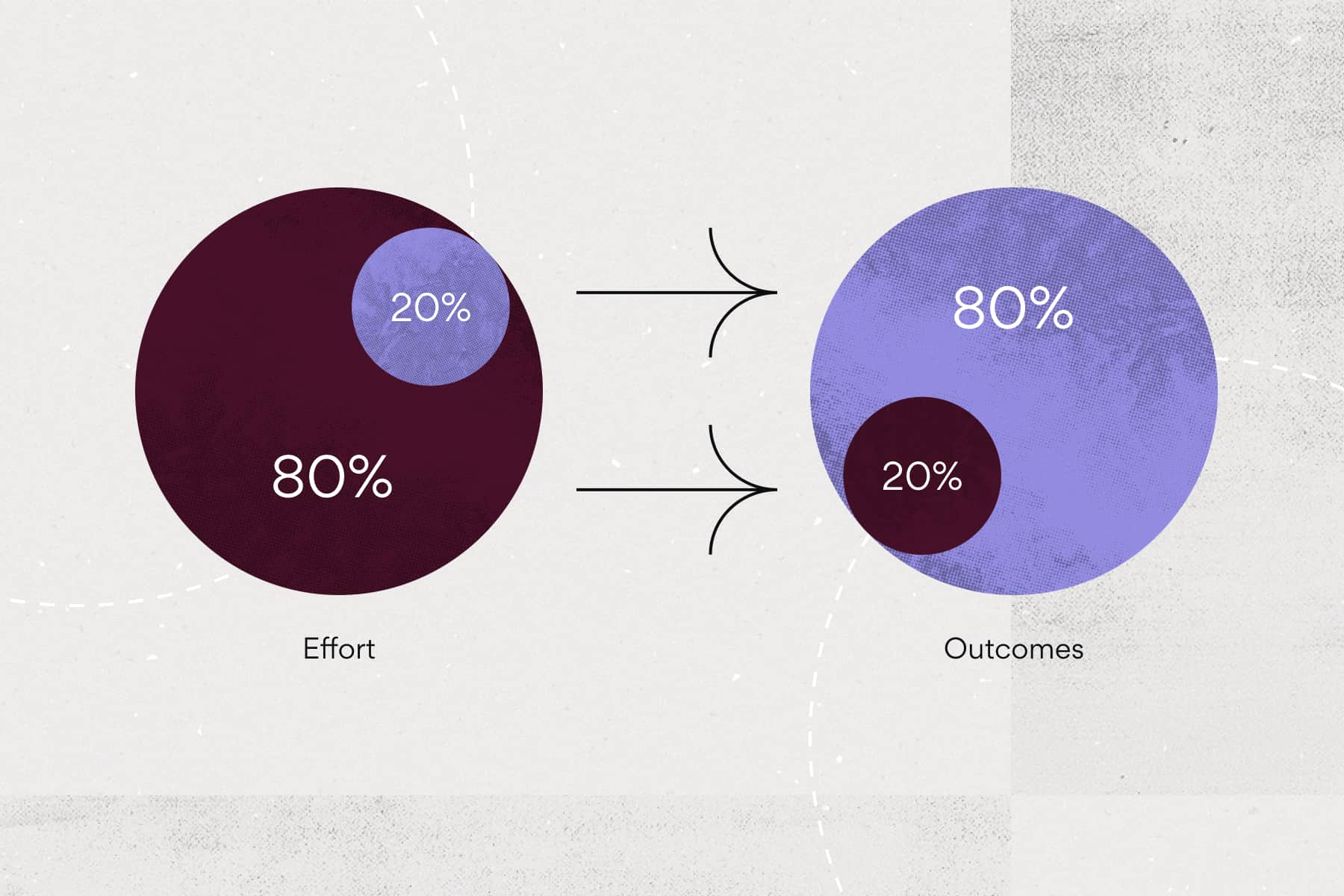
The Pareto principle states that for many outcomes, roughly 80% of consequences come from 20% of causes. A small percentage of causes have an outsized effect. This concept is important to understand because it can help identify which initiatives to prioritize for the most impact.
Where does the Pareto principle come from?
This phenomenon also goes by a couple of different names:
- Pareto principle
- The 80/20 rule (most common)
The 80/20 rule is not a formal mathematical equation. It is a rule of thumb, not a law of nature. It’s observed in economics, business, time management, and even sports.
General examples of the Pareto principle:
- 20% of a plant contains 80% of the fruit
- 80% of a company’s profits come from 20% of customers
- 20% of players result in 80% of points scored
How to use the 80/20 rule
The 80/20 rule applies to almost every industry. The Pareto principle is commonly used in business and economics. This is because the 80/20 rule is helpful in determining where to focus efforts towards maximizing output.
The basis of the Pareto principle states that 80% of results come from 20% of actions. Work that can be segmented into smaller parts allows the Pareto principle to help identify what part of that work is the most influential.
Here are a few examples of how to use the tool in practice.
Productivity
Use the 80/20 rule to prioritize the tasks needing to get done during the day.
Out of the entire task list, completing 20% of those tasks will result in 80% of the impact on that day. So, in order to get the most accomplished, identify which tasks have the most impact and focus on those for the day.
Decision making
The Pareto principle can help you to make the best decisions during the problem-solving process. When there are many causes to one problem, the Pareto principle can help prioritize solutions. Here are a few steps to how this works:
- Identify the problems within this decision-making process.
- Identify the causes of these problems.
- Categorize problems into similar groups. This can help determine if one solution can resolve multiple issues.
- Assign a value to each of these problems based on its impact on the project. The value can be as simple as a number between 1-10, or actual monetary value to show the importance.
- Develop a plan to focus on the top 20% of the problems that impact the project. One solution can resolve multiple problems. Based on the values assigned to each problem, calculate which ones are in the top 20%. Once you’ve identified the main problem, develop a plan to create a solution that can cause 80% of the results using problem-solving strategies.
Example of how to use the 80/20 rule for decision making:
Imagine an ecommerce company. 100 of the most recent customer service complaints come from the fact that customers are receiving damaged products. 80% of refunds given were for damaged products.
Improving packaging to protect products during shipping resolves the issue with customers receiving damaged products.
Quality control
The Pareto analysis and the Pareto chart are key tools used within the Six Sigma quality control methodology.
In the Six Sigma methodology, using a Pareto chart can help visualize your data to identify how to prioritize actions. Six Sigma’s main goal is to reduce the amount of variation in a process with the goal of increasing the amount of production. Pareto charts are common in Six Sigma methodology because they help to identify what most of the variations are in a process.
Advantages of using the Pareto principle
The biggest advantage of using the Pareto principle is to create the maximum amount of impact with the least amount of work. This facilitates the best use of time, focus, and resources.
The 80/20 rule improves metrics by prioritizing initiatives in the right order.
Other benefits of using the Pareto principle:
- Clear priorities
- Increased daily productivity
- Ability to portion work into manageable segments
- More focused strategy
-
Learning
This is a good way to becoming the best you can be. What that is is up to you.
-
Just for YOU
This is an excerpt from Marc and Angel’s Newsletter MarcandAngel.com
You’re likely familiar with what’s known as the Serenity Prayer. It goes like this:
God, grant me the serenity to accept the things I cannot change, the courage to change the things I can, and the wisdom to know the difference.
There’s an important lesson here—one that’s very often glossed over…
When a chaotic reality is swirling around us, we often try to relieve our anxiety by exerting our will over external things we cannot control.
It helps us stave off one of the most dreaded feelings: complete powerlessness.
With that in mind, I have good news and bad news.
The bad news is that generally speaking, almost everything is outside your control. What other people do, whether it will rain tomorrow, whether or not your efforts will be appreciated—all of these outcomes depend on factors that aren’t you.
That’s also the good news.
The friction and frustration created by trying to change things you cannot change is the crucible where a ton of unhappiness is born. Accepting that most things are outside your influence gives you explicit permission to let them unfold as they may.
Stoic philosopher Epictetus put it this way:
“Some things are in our control and others not. Things in our control are opinion, pursuit, desire, aversion, and, in a word, whatever are our own actions. Things not in our control are body, property, reputation, command, and, in one word, whatever are not our actions.”
Overcoming the “three big un’s” that so many of us struggle with daily—unhappiness, unconvinced things will ever change, unsure what to do next—begins with understanding what you can control and what you cannot.
The mental shift here is not easy. Most of us have spent a lifetime worrying about things that we can’t control. Society practically encourages this. For most, it’s a bona fide habit…
A habit that should be replaced with a healthy understanding of how much we can actually change. Again though, it’s hard to get your mind wrapped around all this when you’re constantly hearing…
“Why don’t you just get over it?” “Just let it go.”
We’ve all heard some flavor of this advice before. And it passes the sniff test, to a certain extent.
I mean, “time heals all wounds,” right? Well, yes… sort of. But wounds heal differently depending on how they’re treated.
Left alone, a gash in your skin will leave a large scar and be vulnerable to injury again in the future. This is why we get stitches—it helps the wound heal in a way that limits the chance of re-injury down the road.
Emotional wounds work the same way. Given enough time, most emotional pain will diminish—that’s true.
But just “getting over it” leaves scars.
In the emotional sense, scars equal baggage—baggage we carry with us into every aspect of our lives. These scars grow and accumulate until one day you wake up suffering from one or more of the “three un’s” (unhappiness, unconvinced things will ever change, unsure what to do next).
Don’t get over it. Go through it.
Honestly, I understand the desire to “get over” difficult experiences rather than facing them. Revisiting painful memories and facing our demons is really, really hard. And we’re hard-wired to not cause ourselves pain.
However, as our parents taught us, ignoring a problem doesn’t make it go away.
And in addition to the scars, to ignore or downplay a wound puts you at risk for infection, emotionally as well as physically.
Unresolved issues from the past take up residence in your mind and influence your decisions, your relationships, and your attitudes.
They rob you of your happiness. Doing the hard thing now will be hard, yes. But it’s far better than the alternative.
Of course, doing the hard yet necessary thing can feel impossible.
One way I address this is the practice of being “hootless” meaning that I try to recognize the things I cannot or should not change, relax and just ‘let go’ of those things and let the river flow where it will. While I may influence the behaviour of others, that is best accomplished through example. Thus allowing them to choose their own behaviour rather than ‘shoulding’, bullying or coercing them to accept MY values. After all, aren’t we all responsible for our own choices and the consequences therefrom?
-
Enthusiasm + Purpose = Ambition
Ambition can get a bad rap when it’s paired with words like “greedy,” “selfish,” or “ruthless.” But in actuality, ambition — loosely defined as a strong desire to achieve something through hard work and determination — is the crucial driving force behind accomplishment and action. It’s what marks the difference between a dream and a reality, an idea and a project, a vision and a cultural shift.
Successful folks have long touted the power of ambition in their fields, be it entertainment, business, science, writing, sports, or otherwise — without a certain amount of hope and hunger, it would be too easy to get complacent and merely abide by the status quo. Ambition pushes people to think outside the realm of now and into the possibilities of the future. From there, it’s what motivates us to create, innovate, and explore the uncharted territory of dreams.
Perhaps the trickiest thing about ambition, however, is learning how to define it on our own terms. Or, as actor Santino Fontana so aptly put it, “Be limitless. Be definitionless. Be a pain in the ass for whoever writes your obituary.” Ambition can look different for every person, and can steer each of us toward several worthy pursuits. These 11 inspiring quotes speak to how our aspirations can help recalibrate us to lead our truest, fullest lives.
Our ambition should be to rule ourselves, the true kingdom for each one of us; and true progress is to know more, and be more, and to do more.
— Oscar Wilde, poet and playwright
Don’t be afraid to be ambitious about your goals. Hard work never stops. Neither should your dreams.
— Dwayne “The Rock” Johnson, actor and former athlete
Ambition is the germ from which all growth of nobleness proceeds.
— Ralph Waldo Emerson, writer and philosopher
Those who are crazy enough to think they can change the world usually do.
— Steve Jobs, Apple co-founder
I’m tough, I’m ambitious, and I know exactly what I want. If that makes me a bitch, okay.
— Madonna, singer, songwriter and entrepreneur
Our ambitions can only be limited by our doubts.
— Rajesh, Indian actor and politician
Keep away from people who try to belittle your ambitions. Small people always do that, but the really great make you feel that you, too, can become great.
— Mark Twain, novelist
I think a lot of people dream. And while they are busy dreaming, the really happy people, the really successful people, the really interesting, powerful, engaged people? Are busy doing.
— Shonda Rhimes, TV producer and screenwriter
If you have a great ambition, take as big a step as possible in the direction of fulfilling it. The step may only be a tiny one, but trust that it may be the largest one possible for now.
— Mildred McAfee, first woman commissioned officer in the U.S. Navy
Ambition is enthusiasm with purpose.
— Frank Tyger, editorial cartoonist
We cannot seek achievement for ourselves and forget about progress and prosperity for our community… Our ambitions must be broad enough to include the aspirations and needs of others, for their sakes and for our own.
— Cesar Chavez, labor leader and civil rights activist