Many things in life are hard. We value hard work and extra effort in our culture. BUT, just because you are giving a great effort does not mean you are working toward a great result. How are you making sure that mountain is really worth climbing?
I’m entering the 9th decade of life on this planet and if I have any regrets about the way I’ve chosen to live out that time, it would be that most of my effort has been wasted on unimportant, unnecessary, frivolous endeavors with little or no ultimate value to myself or anyone else.
Flat Squirrel
I’ve always been curious about many things, and possessed with an adventurous spirit. I’ve travelled the world. I’ve supported life, (often not well), with a new job on average, every 2 to 4 years. That’s about how long it takes to burn out or figure out “that mountain ain’t the one I want to climb”. Been many places. Done many things. Jack of all trades, master of none. While I’ve never formally completed higher education certification, I have taken and still take hundreds of courses and read thousands of books. I’m a lifelong learner. I have MID (Multiple Interest Disorder). I still haven’t found THE mountain I REALLY want to climb. I thought I had several times. In the end, they haven’t panned out. Time is running out. While I do enjoy security and a nice lifestyle, I still long for an all-consuming project that will produce something of significance for the world. I love this life. It could be better. I’d like to make it better for those who follow.
Those “flat squirrels” I mentioned are the many past versions of me chasing this, that, or the other “new” trend, “opportunity”, “purpose”, or “calling”. Those squirrels are flat because of poor planning and indecision.
Learning to THINK for YOURSELF and filter all the well intended or otherwise, BS that parents, neighbors, friends, society, culture, academia, and snake-oil salespeople throw at you is the most important mountain anyone can climb.
I think I’ll write a book—maybe a series. I’ve been a wanna-be writer for a very long time.
When you start your day, what’s the first thing you do? Most of us grab our caffeinated beverage of choice, check email, and prioritize tasks for the day. How do we identify what needs to get done first?
One common technique is called the Pareto principle, also known as the 80/20 rule. This technique can help determine and prioritize the highest-impact tasks, thereby increasing productivity throughout the day.
What is the Pareto principle?
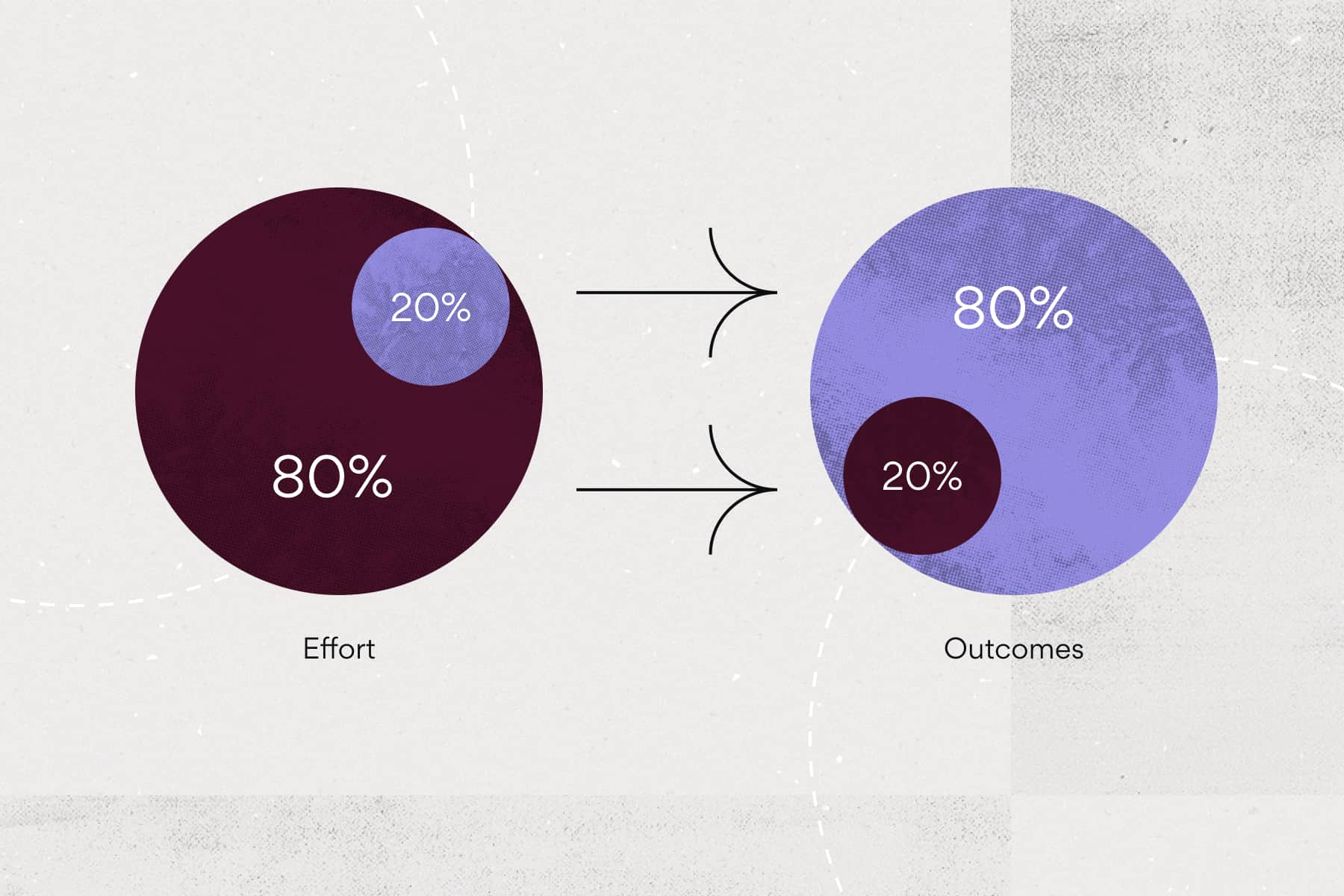
The Pareto principle states that for many outcomes, roughly 80% of consequences come from 20% of causes. A small percentage of causes have an outsized effect. This concept is important to understand because it can help identify which initiatives to prioritize for the most impact.
Where does the Pareto principle come from?
This phenomenon also goes by a couple of different names:
Pareto principle
The 80/20 rule (most common)
The 80/20 rule is not a formal mathematical equation. It is a rule of thumb, not a law of nature. It’s observed in economics, business, time management, and even sports.
General examples of the Pareto principle:
20% of a plant contains 80% of the fruit
80% of a company’s profits come from 20% of customers
20% of players result in 80% of points scored
How to use the 80/20 rule
The 80/20 rule applies to almost every industry. The Pareto principle is commonly used in business and economics. This is because the 80/20 rule is helpful in determining where to focus efforts towards maximizing output.
The basis of the Pareto principle states that 80% of results come from 20% of actions. Work that can be segmented into smaller parts allows the Pareto principle to help identify what part of that work is the most influential.
Here are a few examples of how to use the tool in practice.
Productivity
Use the 80/20 rule to prioritize the tasks needing to get done during the day.
Out of the entire task list, completing 20% of those tasks will result in 80% of the impact on that day. So, in order to get the most accomplished, identify which tasks have the most impact and focus on those for the day.
Decision making
The Pareto principle can help you to make the best decisions during the problem-solving process. When there are many causes to one problem, the Pareto principle can help prioritize solutions. Here are a few steps to how this works:
Identify the problems within this decision-making process.
Identify the causes of these problems.
Categorize problems into similar groups. This can help determine if one solution can resolve multiple issues.
Assign a value to each of these problems based on its impact on the project. The value can be as simple as a number between 1-10, or actual monetary value to show the importance.
Develop a plan to focus on the top 20% of the problems that impact the project. One solution can resolve multiple problems. Based on the values assigned to each problem, calculate which ones are in the top 20%. Once you’ve identified the main problem, develop a plan to create a solution that can cause 80% of the results using problem-solving strategies.
Example of how to use the 80/20 rule for decision making:
Imagine an ecommerce company. 100 of the most recent customer service complaints come from the fact that customers are receiving damaged products. 80% of refunds given were for damaged products.
Improving packaging to protect products during shipping resolves the issue with customers receiving damaged products.
Quality control
The Pareto analysis and the Pareto chart are key tools used within the Six Sigma quality control methodology.
In the Six Sigma methodology, using a Pareto chart can help visualize your data to identify how to prioritize actions. Six Sigma’s main goal is to reduce the amount of variation in a process with the goal of increasing the amount of production. Pareto charts are common in Six Sigma methodology because they help to identify what most of the variations are in a process.
Advantages of using the Pareto principle
The biggest advantage of using the Pareto principle is to create the maximum amount of impact with the least amount of work. This facilitates the best use of time, focus, and resources.
The 80/20 rule improves metrics by prioritizing initiatives in the right order.
Curiosity isn’t always seen in a positive light, in part because of its association with prying into other people’s business. Nosiness. Perhaps that’s why English poet Lord Byron wrote, “I loathe that low vice — curiosity,” in his epic poem Don Juan. And, of course, we all know that curiosity killed the cat, although not so many people know that the original form of that common idiom was actually “care killed the cat” — “care” in this instance, meaning worry or excessive caution.
Perhaps, after all, it is wise to be a little careful with our curiosity. As Albus Dumbledore explained to Harry Potter, “Curiosity is not a sin. But we should exercise caution with our curiosity…” But without our drive to learn, humans wouldn’t have gotten very far. We wouldn’t have progressed in philosophy or science, would never have asked “Who are we?” or sent humans to the moon. Curiosity drives us forward and helps us learn, something that many famous figures have clearly stated, from Walt Disney to Albert Einstein.
Curiosity is, in great and generous minds, the first passion and the last; and perhaps always predominates in proportion to the strength of the contemplative faculties. ― Samuel Johnson
We were lucky enough to grow up in an environment where there was always much encouragement to children to pursue intellectual interests; to investigate whatever aroused curiosity. In a different kind of environment, our curiosity might have been nipped long before it could have borne fruit. — Orville Wright
I have no special talents. I am only passionately curious. ― Albert Einstein
I think, at a child’s birth, if a mother could ask a fairy godmother to endow it with the most useful gift, that gift would be curiosity. — Eleanor Roosevelt
There’s really no secret about our approach. We keep moving forward — opening up new doors and doing new things — because we’re curious. And curiosity keeps leading us down new paths. We’re always exploring and experimenting. ― Walt Disney
Curiosity is the wick in the candle of learning. — William Arthur Ward
Perhaps one day men will no longer be interested in the unknown, no longer tantalized by mystery. This is possible, but when Man loses his curiosity, one feels he will have lost most of the other things that make him human. — Arthur C. Clarke
Millions saw the apple fall, but Newton was the only one who asked why. — Bernard Baruch
Children be curious. Nothing is worse (I know it) than when curiosity stops. Nothing is more repressive than the repression of curiosity. Curiosity begets love. It weds us to the world. It’s part of our perverse, madcap love for this impossible planet we inhabit. People die when curiosity goes. ― Graham Swift
Remember to look up at the stars and not down at your feet. Try to make sense of what you see and wonder about what makes the universe exist. Be curious. — Stephen Hawking
Curiosity is the essence of human existence. Who are we? Where are we? What do we come from? Where are we going? Was there life on Mars? Is Mars like Earth is going to look in a billion years? Are we what Mars looked like a billion years ago. I don’t know. I don’t have any answers to those questions. I don’t know what’s over there and around the corner. But I want to find out. — Gene Cernan, American astronaut
Let’s just say I was testing the bounds of reality. I was curious to see what would happen. That’s all it was: just curiosity. — Jim Morrison
The only reason people do not know much is because they do not care to know. They are incurious. Incuriosity is the oddest and most foolish failing there is.” ― Stephen Fry
Socrates told us, “the unexamined life is not worth living.” I think he’s calling for curiosity, more than knowledge. In every human society at all times and at all levels, the curious are at the leading edge. ― Roger Ebert
The second principle that drives human life flourishing is curiosity. If you can light the spark of curiosity in a child, they will learn without any further assistance, very often. Children are natural learners. It’s a real achievement to put that particular ability out, or to stifle it. Curiosity is the engine of achievement. ― Ken Robinson
Curiosity will conquer fear even more than bravery will. — James Stephens
I think I benefited from being equal parts ambitious and curious. And of the two, curiosity has served me best. ― Michael J. Fox