“Until you make the unconscious conscious, it will direct your life and you will call it fate.” Carl Jung
You do not find a happy life. You make it..
Professor Feynman
“Until you make the unconscious conscious, it will direct your life and you will call it fate.” Carl Jung
You do not find a happy life. You make it..
Professor Feynman
All of humanity’s problems stem from man’s inability to sit quietly in a room alone.
Blaise Pascal
We’re waking up, becoming more aware, but will our “awakening” be enough, and soon enough?
The first and overarching Big Problem is to make the Good Person. We must have better human beings or else it is quite possible that we may all be wiped out, and even if not wiped out, certainly live in tension and anxiety as a species… This Good Person can equally be called the self-evolving person, the responsible-for-himself and his-own-evolution person, the fully illuminated or awakened or perspicuous man, the fully human person, the self-actualizing person, etc.”
Abraham Maslow
Our age has shifted all emphasis to the here and now, and thus brought about a demonization of man and his world. The phenomenon of dictators and all the misery they have wrought springs from the fact that man has been robbed of transcendence by the shortsightedness of the super-intellectuals. Like them, he has fallen a victim to unconsciousness. But man’s task is the exact opposite: to become conscious of the contents that press upward from the unconscious. Neither should he persist in his unconsciousness, nor remain identical with the unconscious elements of his being, thus evading his destiny, which is to create more and more consciousness. As far as we can discern, the sole purpose of human existence is to kindle a light in the darkness of mere being. It may even be assumed that just as the unconscious affects us, so the increase in our consciousness affects the unconscious.
Carl Jung
For, as all exponents of the Perennial Philosophy have constantly insisted, man’s obsessive consciousness of, and insistence on being, a separate self is the final and most formidable obstacle to the unitive knowledge of God. To be a self is, for them, the original sin, and to die to self, in feeling, will and intellect, is the final and all-inclusive virtue.
Aldous Huxley
Albert Einstein called the intuitive or metaphorical mind a sacred gift. He added that the rational mind was a faithful servant. It is paradoxical that in the context of modern life, we have begun to worship the servant and defile the divine.
Bob Samples
Life in the 21st century demands mindfulness—getting to know ourselves better and seeing how we contribute to suffering in our own lives.
Bill Gates
One great challenge of modern life is to find the staircase (consciousness / self-transcendence) amid all the clutter, and then to do something good and noble once you climb to the top.
Johathan Haidt
Transcendence refers to the very highest and most inclusive or holistic levels of human consciousness, behaving and relating, as ends rather than means, to oneself, to significant others, to human beings in general, to other species, to nature, and to the cosmos.
Abraham Maslow
The salvation of this human world lies nowhere else than in the human heart, in the human power to reflect, in human modesty, and in human responsibility. Without a global revolution in the sphere of human consciousness, nothing will change for the better… and the catastrophe toward which this world is headed, whether it be ecological, social, demographic or a general breakdown of civilization, will be unavoidable.
Vaclav Havel
We traded our birthright as partners in the drama of the living mind of the planet for the broken pot shards of history, warfare and neurosis. If we do not quickly awaken to our predicament? Planetary catastrophe.
Terence Mckenna
Peace can only come as a natural consequence of universal enlightenment…
Nikola Tesla
The only real revolution is in the enlightenment of the mind and the improvement of character. The only real emancipation is individual, and the only real revolutionists are philosophers and saints.
Will & Ariel Durant
The problem in the West is people want enlightenment to be fast, to be easy, and, if possible, cheap.
Matthieu Ricard quoting Dalai Lama
There can be only one permanent revolution—a moral one; the regeneration of the inner man. How is this revolution to take place? Nobody knows how it will take place in humanity, but every man feels it clearly in himself. And yet in our world everybody thinks of changing humanity, and nobody thinks of changing himself.
Leo Tolstoy
There is only one perpetrator of evil on the planet: human unconsciousness. That realization is true forgiveness. With forgiveness, your victim identity dissolves, and your true power emerges—the power of Presence. Instead of blaming the darkness, you bring in the light.
Eckhart Tolle
The mystics, saints, and others make great efforts to wake people up. If they don’t wake up, they’re always going to have these other minor ills like hunger, wars, and violence. The greatest evil is sleeping people, ignorant people… The only tragedy there is in the world is ignorance; all evil comes from that. The only tragedy there is in the world is unwakefulness and unawareness. From them comes fear, and from fear comes everything else.
Anthony de Mello
There are more people on the planet today thinking for themselves than ever before.. Now, for the first time, a huge massive number of people are thinking for themselves.
Sadhguru
The public has an insatiable curiosity to know everything, except what is worth knowing.
Oscar Wilde
Thinking is the hardest work there is, which is the probable reason so few engage in it.
Henry Ford
The world as we have created it is a process of our thinking. We cannot change it without changing our thinking.
Albert Einstein
The saddest aspect of life right now is that science gathers knowledge faster than society gathers wisdom.
Isaac Asimov
We are drowning in information, while starving for wisdom. The world henceforth will be run by synthesizers, people able to put together the right information at the right time, think critically about it, and make important choices wisely.
E. O. Wilson
We are living in space-age times with people who are living with Stone Age minds.
Daryl Davis
The real problem of humanity is the following: we have Palaeolithic emotions; medieval institutions; and god-like technology. And it is terrifically dangerous, and it is now approaching a point of crisis overall… until we answer those huge questions of philosophy that the philosophers abandoned a couple of generations ago—Where do we come from? Who are we? Where are we going?–rationally.
E. O. Wilson
Democracy is the most difficult of all forms of government, since it requires the widest spread of intelligence, and we forgot to make ourselves intelligent when we made ourselves sovereign.
Will & Ariel Durant
The most urgent problems of our world today are the problems we have made for ourselves. They are human problems whose solutions will require us to change our behavior and our social institutions.
George Miller
The best thing a human being can do is to help another human being know more.
Charlie Munger
When I think about the world today and the challenges facing mankind, I don’t think the problems are technical. I think they’re human.
Nichol Bradford
In order to make peace with technology, we have to make peace with ourselves.
Tristan Harris
Responding to a radical crisis that threatens our very survival–this is humanity’s challenge now. The dysfunction of the egoic human mind, recognized already more than 2,500 years ago by the ancient wisdom teachers and now magnified through science and technology, is for the first time threatening the survival of the planet.
Eckhart Tolle
Thus for the first time since his creation man will face his real, his permanent problem—how to use his freedom from pressing economic cares, how to occupy the leisure, which science and compound interest will have won for him, to live wisely and agreeably and well.
John Maynard Keynes
Good nature is, of all moral qualities, the one that the world needs most, and good nature results from ease and security, not from a life of arduous struggle. Modern methods of production have given us the possibility of ease and security for all; we have chosen instead to have overwork for some and starvation for others. Hitherto, we have continued to be as energetic as we were before there were machines. In this, we have been foolish, but there is no reason to go on being foolish forever.
Bertrand Russell
In a few hundred years, when the history of our time will be written from a long-term perspective, it is likely that the most important event historians will see is not technology, not the internet, not e-commerce. It is an unprecedented change in the human condition. For the first time—literally, substantial and rapidly growing numbers of people have choices. For the first time, they will have to manage themselves. And society is totally unprepared for it.
Peter Drucker
The great challenge of the twenty-first century is to raise people everywhere to a decent standard of living while preserving as much of the rest of life as possible.
E. O. Wilson
Reducing inequity is the highest human achievement.
Bill Gates
Abundance is harder for us to handle than scarcity.
Nassim Nicholas Taleb
Most of modern life, all our diseases, are diseases of abundance, not diseases of scarcity.
Naval Ravikant
Creativity is the last frontier… automation over a long enough period will replace every non-creative job… that’s great news. That means that all of our basic needs cared for, and what remains for us is to be creative, which is really what every human wants.
Naval Ravikant
The machines came and took away the power of your muscle. Now machines are coming which will take away the power of your memory (referring to intelligence/intellect)… in the future, the only thing that matters is what kind of human being are you?
Sadhguru
The Earth is a very small stage in a vast cosmic arena. Think of the rivers of blood spilled by all those generals and emperors so that, in glory and triumph, they could become the momentary masters of a fraction of a dot. Think of the endless cruelties visited by the inhabitants of one corner of this pixel on the scarcely distinguishable inhabitants of some other corner, how frequent their misunderstandings, how eager they are to kill one another, how fervent their hatreds. Our posturings, our imagined self-importance, the delusion that we have some privileged position in the universe, are challenged by this point of pale light. Our planet is a lonely speck in the great enveloping cosmic dark. In our obscurity, in all this vastness, there is no hint that help will come from elsewhere to save us from ourselves.
Carl Sagan, Pale Blue Dot
You develop an instant global consciousness, a people orientation, an intense dissatisfaction with the state of the world, and a compulsion to do something about it. From out there on the moon, international politics look so petty. You want to grab a politician by the scruff of the neck and drag him a quarter of a million miles out and say, ‘Look at that, you son of a bitch.’
Edgar Mitchell, Apollo 14 Astronaut
Priorities must be Planet-Society-Economy as opposed to Economy-Society-Planet… The reality of the world is that the economy is the wholly owned subsidiary of the biosphere.
Ron Garan, Astronaut
Driven by greed, ignorant of their connectedness to the whole, humans persist in behavior that, if continued unchecked, can only result in their own destruction.
Eckart Tolle
There are no borders or boundaries on our planet except those that we create in our minds or through human behaviors. All the ideas and concepts that divide us when we are on the surface fade from orbit and the moon. The result is a shift in worldview and in identity.
Frank White
Your definition of the word ‘home’ would rapidly expand to encompass the planet in its entirety, and for the first time, you might fully understand what it means to be one human family.
Ron Garan, Astronaut
Thousands of tired, nerve-shaken, over-civilized people are finding out that going to the mountains is going home; that wildness is a necessity.
John Muir
I’ve often heard people say: ‘I wonder what it would feel like to be on board a spaceship,’ and the answer is very simple. What does it feel like? That’s all we have ever experienced. We are all astronauts on a little spaceship called Earth.
Buckminster Fuller
Earth is not a platform for human life. It’s a living being. We’re not on it, but part of it. Its health is our health.
Thomas Moore
In the 1980s, simplicity was seen primarily as downshifting, or pulling back from the rat race of consumer society. Several decades later, there is a growing recognition of simplicity as up shifting—or moving beyond the rat race to the human race.
Duane Elgin
The solution to a lot of the world’s problems may be to turn around and take a forward step.
Yvon Chouinard
Humanity can still prosper for 150,000 years… but this depends on choosing a voluntary simplicity… growing qualitatively, not quantitatively.
Matthieu Ricard
Voluntary simplicity does not mean a return to a more primitive past, but a movement ahead to a more sophisticated, compassionate, and collaborative future
Duane Elgin
The goal of life is to make your heartbeat match the beat of the universe, to match your nature with nature.
Joseph Campbell
As the concerns of survival recede, human beings will naturally evolve into perceiving higher things.
Sadhguru
For too long we have been dreaming a dream from which we are now waking up: the dream that if we just improve the socioeconomic situation of people, everything will be okay, people will become happy. As the struggle for survival has subsided, the question has emerged: survival for what? Ever more people today have the means to live, but no meaning to live for.
Viktor Frankl
The mystery of human existence lies not in just staying alive, but in finding something to live for.
Fyodor Dostoyevsky
Only a small proportion of the human population gets to the point of identity, or selfhood, full humanness, self-actualization, etc., even a society like ours, which is relatively one of the most fortunate on the face of the earth. This is our great paradox. We have the impulse toward full development of humanness. Then why is it that it doesn’t happen more often? What blocks it?
Abraham Maslow
Maslow defined self-actualization as discovering what you are meant to do and committing to the ardor of pursuing it with excellence. The purpose of free society, I would suggest, is to systematically increase the percentage of people who do exactly that.
Jim Collins
Despite the severity of our physical problems, our deepest challenge is to overcome an invisible crisis: a lack of collective consensus and cohesion around a compelling sense of purpose
Duane Elgin
The most foundational challenge facing humanity is not devising solutions to the energy crisis or climate crisis; rather, it is bringing visions and narratives of the human journey into our collective awareness that empowers us to look beyond a future of great adversity and to see a future of great opportunity.
Duane Elgin
As tribal cultures developed into ancient civilizations, they allotted certain functions to certain people: ruler, priest or priestess, warrior, farmer, merchant, artisan, craftworker, laborer, and so on. A class system developed. Your function, which in most cases you were born into, determined your identity, determined who you were in the eyes of others, as well as in your own eyes. Your function became a role, but they did not recognize it as a role: it was who you were, or thought you were. Only rare beings such as the Buddah or Jesus, saw the ultimate irrelevance of caste or social class, recognized it as an identification with form, and saw that such identification with the conditioned and the temporal obscured the light of the unconditioned and eternal that shines in each human being. In our contemporary world, the social structures are less rigid, less clearly defined than they used to be. Although most people are, of course, still conditioned by their environment, they are no longer automatically assigned a function and, with it an identity. In face, in the modern world, more and more people are confused as to where they fit in, what their purpose is, and even who they are.
Eckhart Tolle
Many people who are going through the early stages of the awakening process are no longer certain what their outer purpose is. What drives the world no longer drives them. Seeing the madness of our civilization so clearly, they may feel somewhat alienated from the surrounding culture. Some feel that they inhabit a no-man’s-land between two worlds. They are no longer run by the ego, yet the arising awareness had not yet become fully integrated into their lives. Inner and outer purpose have not merged.
Eckhart Tolle
Then comes the reconciliation of outer and inner purpose: to bring that essence-consciousness-into the world of form and transform the world. The ultimate purpose of that transformation goes far beyond anything the human mind can imagine or comprehend. And yet, on this planet, that transformation is the task allotted to us. That is the reconciliation of outer and inner purpose, the reconciliation of the world and God.
Eckhart Tolle
Don’t we all want to change the world? Do our part to make the world a better place, change humanity’s consciousness, mind, work, nature, and meaning?
Paradoxically, the best and only place really, is to start with yourself.
Busy remaking the world, man forgot to remake himself.
Andrei Platonov
Yesterday I was clever, so I wanted to change the world. Today I am wise, so I am changing myself.
Rumi
There is only one corner of the universe you can be certain of improving, and that’s your own self.
Aldous Huxley
It’s easier to change yourself than to change the world… Live the life you want other people to live.
Naval
The place to improve the world is first in one’s own heart and head and hands, and then work outward from there.
Robert M. Pirsig
If it’s true that “the macrocosm reflects the microcosm,” then you’d see the cumulative and compounding effects of more and more humans taking personal responsibility for their own lives.
Your own self-realization is the greatest service you can render the world.
Sri Ramana Maharshi
To end the misery that has afflicted the human condition for thousands of years, start with yourself and take responsibility for your inner state. That means now.
Eckhart Tolle
The character of a society is the cumulative result of the countless small actions taken day in and day out by millions of persons. Small changes that may seem unimportant in isolation are of transformative significance when adopted by an entire society.
Duane Elgin
There is something greater than history. Somewhere, sometime, in the name of humanity, we must challenge a thousand evil precedents, and dare to apply the Golden Rule to nations..
Will & Ariel Durant
A meditation on meaning that explores the non-linear ways life progresses beyond a simple conception of a personal mission.
A common misperception many of us have regarding a meaningful life is that we have a special purpose in life—and that once we find it, all our confusion ends. We’re saved from the happenstance and absurdity of our lives.
While some people may discover a mission that does this, most of us will not—at least not in a way that makes for a good “Hero’s Journey” story.
Our infatuation with stories portraying “the hero’s journey” select for meaning stories that scratch a certain human itch. They project a narrative simplicity backwards onto lives full of false leads, crises, and dead ends. They gloss over long periods of despair, the noise of randomness, the elements of chance, and personal and moral failings to tell the story of someone special who carried out a special mission. We have been told these stories all our lives, so we have deeply internalized them. “If only I could find my purpose!” And there’s actually truth to this. It’s me. It’s the story of my life.
There is an alternate truth to my life as well. It’s premised on the idea that life is full of randomness punctuated by sudden moments—crises and opportunities—with vast potential for meaning making, when our skills and virtues shine.
Rather than struggle to discover a purpose or vocation, we become people who can recognize and exploit opportunities to create meaning as they arise—resourceful and audacious people who live adventurous lives.
This approach means not waiting to find your story arc, but recognizing that there are stories that pop up which you can opt into if you recognize them and have the right skills and virtues. It is about being prepared for the call to adventure, and cultivating the ability to recognize it, rather than believing we can direct our lives from the perspective of some knowable, ultimate mission (purpose).
Your class, your caste, your country, sect, your name or your tribe, there’s people always dying trying to keep them alive.”
Bright Eyes
The meaning I’m talking about is the kind that relieves a certain despair—the despair that comes from knowing that we must suffer and die and wondering if anything can be worthwhile in the face of these facts.
Some sources of meaning seem to be:
Some people may find their sense of meaning is satisfied entirely from one of the above sources. Most of us, however, develop a portfolio of meaning—we have multiple sources of it in our lives, and cannot in fact derive it from only one source any more than we can be healthy on a diet of bread and water.
The linear approach imagines that the meaning of our lives can be reduced to a mission, like the kind that fixes saints, heroes and social reformers in the historical imagination. “Created a vaccine.” “Expelled an occupier.” “Founded a religious order.” Of course, these accomplishments may admit multiple achievements or adventures—but are usually reduced to one overarching narrative.
This imagines that if we found a sufficiently noble cause to devote our lives to—one to which our talents were suited and appropriate—we would be free to the suffering that is caused by the knowledge of death (and the possibility that it might strike at any time).
Of course, there are people who have been personally fulfilled from devoting their life to a cause. For many, though, it does not work—our noble causes run into moral complexities on the ground, or are mirages based on a distorted vision of the world. They may leave us open to manipulation by careerist sociopaths, who know that we will chase any projected image that offers a shred of meaning, like a cat chasing a laser dot.
The non-linear approach is different—rather than trying to discover a particular arc path and follow it to its conclusion, it recognizes that there will be many moments and opportunities to create meaning that arise in our life. The idea is not that we will take part in one story that can be easily wrapped up by our biographers—but that there are many adventures and quests that we can pursue. Rather than the attitude of the saint who is given a mission by God, it takes the attitude of the swashbuckling adventurer who goes out to seek his fortune.
Instead of imagining yourself as the hero of a Hollywood movie, imagine yourself as a hearty ancestor that you might brag about when drunk: the one who rode bareback, founded a town, fought a grizzly bear, raised 10 kids, saved her son’s life by drinking the governor under the table, and went to the frontier to stay one step ahead of the hangman and her gambling debtors.
This approach to the problem of meaning recognizes that, rather than trying to discern a mission, it is better to become a certain person—a person who can act on and recognize opportunities to make meaning when they are seen.
One advantage of the non-linear approach is that it does not demand that we devote every spare moment of our time to fulfilling some pre-ordained goal. It is more adaptive to the realities of power laws—of moments of high payoff or high risk—than of the day-to-day grind of accrual. If our lives are rich in opportunities for meaning, rather than defined by a singular narrative arc, we can act decisively at particularly important moments rather than imagining that every moment is equally meaningful. There are profound asymmetries and power laws at play in the pursuit of meaning—a split second decision might be the most important one you make; years of lounging around in cafes and on beaches might pay off more than years of hard work—if it results in one excellent idea.
Trying to treat all of our time as equally meaningful and fungible because you can devote it to The Cause leads to absurdities. Consider this example of someone debating whether he should tell someone their car trunk is open:
Time is not fungible—a moment of opportunity, or a chance to respond appropriately to a crisis, might not occur again. Our creative powers do not flow smoothly and evenly like water from the tap to the drain, but chaotically like a babbling brook going from the mountains to the ocean—with different shoals, rapids, pools, and speeds along the way. Believing that our efforts must flow from smooth, even and continuous effort rather than coming in uneven bursts leads to unnecessary guilt and anxiety about “wasted” time.
The need to regulate our time into a continuous flow is the result of the agricultural and industrial revolutions. It is something we do to serve economies of scale in which we are interchangeable parts. But meaning, creative power and fortune arrive on their own schedules, and imagining that you can or should devote every waking moment to something is absurd.
When there is only one possible source of meaning in our life, we adapt ourselves for efficiency: our goal might be to win souls for Jesus, or stop Skynet. We make ourselves machine-like. When the world is full of possibilities for meaning, we adapt ourselves for resiliency, flexibility and maneuverability. Resiliency, because we must survive long enough to take advantage of these latent sources of meaning, and flexibility, and maneuverability in order to act quickly and appropriately when they come up. Instead of looking for a cause to devote your life to, you might try to become someone who is useful and level-headed in a crisis, who is well connected and makes friends easily, or who regularly has good ideas.
Giving up on a life’s purpose does not mean there are not areas which are more fruitful to pursue than others. When you are interested in something, this suggests a fertile area. If nothing else, interests represent low-hanging fruits of reward-to-effort payoff: when you are pursuing an interest, rather than an obligation, you can use the energy you would otherwise need to browbeat yourself into actually doing things. Therefore it seems so easy to read about whatever your personal obsession is – astrology, kabbalah, entomology – rather than whatever the marketplace or superego tells you should pursue – tax law, Bible study, a programming language (these are examples only many people have interests or disinterests in these subjects!) Like the God of the Old Testament, we will love whom we will love, and we will be fascinated by that which fascinates us.
If we have an interest, there is a challenge to make it meaningful – with some things, this will be easier than others, because our culture that tells us how to do has given a script to us so. More obscure interests represent more of a challenge – but also easy opportunities. A quick glance at the internet will reveal artists who are using new media to create works of brilliance in unexpected places. There are Twitter threads made by anonymous writers which contain more insight than most published academic papers, and memes which capture the human condition better than most works found in art galleries. Your heroes become what they were by breaking genuinely new ground – doing things that those before them thought were unthinkable. To be like them, you must surf the void at the frontiers of meaning – and discover meaning where no one else thought it would be, transforming harsh barrens into lush gardens.
The linear approach of finding a mission and dedicating one’s life to it – is typically best for those who have an overpowering, obsessive interest in something. If you are like this, chances are this article is not for you, and you are not grasping at meaning but hoping to read more about the Thing which so consumes your thoughts. If this is the case, your vocation has already chosen you.
Because several loci of meaning – pro-social utility, love, and self transcendence – involve escapes from our localized self interest, we can feel guilt or a dearth of meaning when we act selfishly, when we cannot love as often or as deeply as we should, or when our interests do not lead down paths which generate surpluses and resources for others.
Sometimes it is, in fact, necessary to put others first – you may have to take time out from your career or hobby to care for a child or an ailing parent, or to help your community or nation deal with some crisis. You may realize that you are spending too much time in the workshop and not enough time with your children. But taken too far, this thinking can also produce crippled, resentful individuals who give back only a fraction of what they would have if they were flourishing. Your children need food, clothes and education, and they need your love and guidance – but they also need to see you happy and engaged with life.
Most of us have probably met some version of the pinched and crabby moralist – one who dedicated his or her life to some cause and did not get the spiritual payoff they thought they would, and are now resentful and controlling. There was a time when this was me. Thankfully, that period is part of my past.
Instead of selflessness, strive for integrity. When you create, it should be things you think are good – that honestly portray your inner and outer world as best you are able. When you are honestly pursuing your own values and vision – and not subordinating them – you are more likely to generate meaning than if you are navigating a maze of compromises with some goal in mind. Especially if these compromises are dictated to you by a nagging superego that torments you with an image of moral heroism which you can never live up to.
This requires faith and willingness to trust your values and intuitions rather than the well-worn stories dictated to you by culture. Recognize that the heroes whose lives inspired you did what they did, mostly by going out into the unknown and doing what others thought was impossible. This is not, incidentally, a guarantee that if you do so you will succeed – for the world to be a meaningful one, there must be uncertainty and risk.
This approach to meaning – becoming a certain kind of person who can act appropriately in response to opportunities for meaning making – lends itself well to a particular school of meta-ethics, which is virtue ethics. Deontology, (a study of duty and obligations) represents the ethics of duty: the floor beneath which we must not sink, if we are to co-operate with others to pursue the goods of survival and flourishing. Consequentialism is the ethics of power and emergency, when there are clearly defined stakes which must be traded off against one another. In its utilitarian version, if flounders, precisely because a definition of “the good” requires more legibility than is typically available: of both our own values and the results of our actions in a real-world environment.
The non-linear approach to meaning is about becoming the person who will, given a chance, act effectively to realize their values in this world, even if those values are not articulable except as a felt sense of meaning. It requires us to become developed along multiple axes of development: capable of risking it all in a dangerous, uncertain and beautiful world full of hazard and opportunity.
Learning how to think really means learning how to exercise some control over how and what you think. It means being aware enough to choose what you pay attention to and to choose how you construct meaning from experience. Exercising this kind of choice will put you miles ahead in life.
This is a good way to becoming the best you can be. What that is is up to you.
An entire sea of water can’t sink a ship unless it gets inside the ship. Similarly, the negativity of the world can’t put you down unless you allow it to get inside you.”
Unknown
Science begets knowledge (knowing). Opinion begets ignorance (speculation)”
Charles Tutt
Truth IS. Lies are invented”
Charles Tutt
This is an excerpt from Marc and Angel’s Newsletter MarcandAngel.com
You’re likely familiar with what’s known as the Serenity Prayer. It goes like this:
God, grant me the serenity to accept the things I cannot change, the courage to change the things I can, and the wisdom to know the difference.
There’s an important lesson here—one that’s very often glossed over…
When a chaotic reality is swirling around us, we often try to relieve our anxiety by exerting our will over external things we cannot control.
It helps us stave off one of the most dreaded feelings: complete powerlessness.
With that in mind, I have good news and bad news.
The bad news is that generally speaking, almost everything is outside your control. What other people do, whether it will rain tomorrow, whether or not your efforts will be appreciated—all of these outcomes depend on factors that aren’t you.
That’s also the good news.
The friction and frustration created by trying to change things you cannot change is the crucible where a ton of unhappiness is born. Accepting that most things are outside your influence gives you explicit permission to let them unfold as they may.
Stoic philosopher Epictetus put it this way:
“Some things are in our control and others not. Things in our control are opinion, pursuit, desire, aversion, and, in a word, whatever are our own actions. Things not in our control are body, property, reputation, command, and, in one word, whatever are not our actions.”
Overcoming the “three big un’s” that so many of us struggle with daily—unhappiness, unconvinced things will ever change, unsure what to do next—begins with understanding what you can control and what you cannot.
The mental shift here is not easy. Most of us have spent a lifetime worrying about things that we can’t control. Society practically encourages this. For most, it’s a bona fide habit…
A habit that should be replaced with a healthy understanding of how much we can actually change. Again though, it’s hard to get your mind wrapped around all this when you’re constantly hearing…
“Why don’t you just get over it?” “Just let it go.”
We’ve all heard some flavor of this advice before. And it passes the sniff test, to a certain extent.
I mean, “time heals all wounds,” right? Well, yes… sort of. But wounds heal differently depending on how they’re treated.
Left alone, a gash in your skin will leave a large scar and be vulnerable to injury again in the future. This is why we get stitches—it helps the wound heal in a way that limits the chance of re-injury down the road.
Emotional wounds work the same way. Given enough time, most emotional pain will diminish—that’s true.
But just “getting over it” leaves scars.
In the emotional sense, scars equal baggage—baggage we carry with us into every aspect of our lives. These scars grow and accumulate until one day you wake up suffering from one or more of the “three un’s” (unhappiness, unconvinced things will ever change, unsure what to do next).
Don’t get over it. Go through it.
Honestly, I understand the desire to “get over” difficult experiences rather than facing them. Revisiting painful memories and facing our demons is really, really hard. And we’re hard-wired to not cause ourselves pain.
However, as our parents taught us, ignoring a problem doesn’t make it go away.
And in addition to the scars, to ignore or downplay a wound puts you at risk for infection, emotionally as well as physically.
Unresolved issues from the past take up residence in your mind and influence your decisions, your relationships, and your attitudes.
They rob you of your happiness. Doing the hard thing now will be hard, yes. But it’s far better than the alternative.
Of course, doing the hard yet necessary thing can feel impossible.
One way I address this is the practice of being “hootless” meaning that I try to recognize the things I cannot or should not change, relax and just ‘let go’ of those things and let the river flow where it will. While I may influence the behaviour of others, that is best accomplished through example. Thus allowing them to choose their own behaviour rather than ‘shoulding’, bullying or coercing them to accept MY values. After all, aren’t we all responsible for our own choices and the consequences therefrom?
You, I, nor anyone else have any control over the lotteries of DNA, economic, social, religious, cultural, or any other circumstances into which we were born. Yet, I do not regret being born. Indeed, I’m very grateful for being born—warts and all. How about you? And if you, like me, are grateful; do you believe anyone has a right to deny life to another? Personally, I strongly favor every individual’s right to be born, to learn, grow and optimize their own potential, whatever that may be.
I resonated with the following book review. I hope you like it too. There’s more stuff like this on the website: http//www.lesswrong.com.
(Book Review) The Genetic Lottery: Why DNA Matters for Social Equality
Lottery: Why DNA Matters
for Social Equality by Xylitol 7th Oct 2021
Book Reviews Human Genetics Education Psychology World Modeling
Consider this: your child is struggling in school. What might be going on? Perhaps home life is chaotic and stressful. Perhaps the school itself lacks resources. Maybe other kids bully them because of their kinky hair or strange accent or their hand-me-down clothing. But Kathryn Paige Harden, in her book The Genetic Lottery: Why DNA Matters for Social Equality, argues that we’re still missing something important—your kid’s genes.
Her book, and much of her research, focuses on how genes affect educational attainment, and for good reason—education and well- being are connected, especially in America. For example, the adult life expectancy of Black Americans with a bachelor’s degree is now closer to white Americans with a degree than to Black Americans without a degree. This gap in how education affects life expectancy is widening, even as the corresponding racial and gender gaps in life expectancy are narrowing. So if you’re concerned about social inequalities, you should be concerned with education.
According to Harden, genes predict educational attainment just about as well as family income does. Which is to say, a good bit! And because genes are just as unearned as other benefits of one’s birth, Harden wants to use genetic knowledge to improve social policy and create a more egalitarian, anti-eugenic future:
Like being born to a rich or poor family, being born with a certain set of genetic variants is the outcome of a lottery of birth. You didn’t get to pick your parents, and that applies just as much to what they bequeathed you genetically as what they bequeathed you environmentally. And, like social class, the outcome of the genetic lottery is a systemic force that matters for who gets more, and who gets less, of nearly everything we care about in society.
Her Argument
If you’ll remember, the book’s subtitle is Why DNA Matters for Social Equality. So, why does it? Harden’s central argument is quite simple:
Her argument is pretty convincing. We haven’t really tried to use genetic knowledge to improve social policy, so why not try? But Harden is bringing genes into the picture here, so she’s got to distinguish herself from the genetic conservative standpoint, typified by Charles Murray of The Bell Curve, lest she be the next person to get punched at Middlebury. To Harden, genetic conservatives believe three things:
First, that the causal chain between genetics and social inequality is short and primarily mediated via the development of intelligence. Second, that the causal chain between genetics and social inequality is best understood at a cellular and organismic level of analysis, with intelligence seen as an inherent property of a person’s brain, rather than as something that develops in a social context. And, third, that the alternative possible worlds where this chain is broken are dystopian, requiring either massive state intrusion into people’s home lives or widespread genetic engineering.
In other words, they’re determinists and pessimists. You can’t change this stuff through social policy, stupid! The causal chain from genetics to outcomes is too short and strong to break! But Harden is neither a determinist nor a pessimist, and she gives a couple of examples where social policy can intervene between genetic cause and outcome.
First, glasses: Nearsightedness is heritable, we use glasses to address it, and glasses are not a genetic solution. Et voila! A social intervention for a genetic problem. Second, verbal fluency: The time when a child starts talking is heritable. But when a child starts talking earlier, this encourages the parent to talk with them more and use a larger vocabulary. This improves the child’s ability to speak, leading to more interaction, more stimulation, and even greater verbal fluency. It’s a positive feedback loop that’s socially mediated! A potential policy intervention might just look like a social worker telling a parent, “Even if your kid doesn’t start talking by age two, make sure that you still talk with them often, because that will help them speak.”
Given this premise, let’s jump into the research…
A Tree with Rotten Roots
…or not. Harden has, uh, a few tripwires to avoid first. The early chapters of Lottery walk through a potted history of statistics and genetics, describing how many progenitors of those fields believed in deep and fixed human hierarchies, and how research in those fields has been used to justify and oppressively reinforce those hierarchies. Galton, Fisher, Pearson; exclusion, sterilization, murder. It’s horrible and fairly well known.
But ignoring how genes affect outcomes, Harden says, exposes us to two terrible consequences: First, we’ll fail to help the most vulnerable, since we cannot enact informed, effective social policy. Second, we’ll cede the intellectual landscape to purveyors of anti- egalitarianism and eugenics, since all we can do is scream la la la I can’t hear you! as inconvenient data keeps flowing in that, you know, genetics kinda matters.
Given the dangers, though, let’s make a few things clear: The genetics research described here can only tell you about genetic differences within an ancestry group, not between those groups. Ancestry groups are not racial groups—racial groups are social constructs that only have extremely tenuous links to biology.[1]These studies cannot and should not be used to explain anything about racial gaps in educational attainment, test scores, and such.
Okay, now let’s jump into the research…
Goodbye Candidate Genes, Hello GWAS
In the days of yore, when the human genome was first mapped, we believed we would soon find strong links between particular genes and particular outcomes. Think “the gay gene” or “the depression gene.” This model—the candidate gene—is wrong for most things, and the research design it entails has produced little (but not zero) scientific knowledge. At times, it even created entire cottage industries of researchers waving around red herrings like broadswords—such as in the case of 5-HTTLPR, the serotonin transporter gene. To explain this, Harden pulls in a familiar figure:
Liberated from the polite conventions of scientific journals, the psychiatrist and blogger Scott Siskind summarized the paper’s conclusion [about the 5-HTTLPR candidate gene] more colorfully. He denounced investigators who reported “results” on 5-HTTLPR as fabulists telling stories about unicorns, except worse: “This isn’t just an explorer coming back from the Orient and claiming there are unicorns there. It’s the explorer describing the life cycle of unicorns, what unicorns eat, all the different subspecies of unicorn, which cuts of unicorn meat are tastiest, and a blow-by-blow account of a wrestling match between unicorns and Bigfoot.”
So when does the candidate gene model fail? When tons and tons of genetic variants each provide a very small effect. To study genetic effects of this type, you need a new kind of research design—a genome-wide association study, or GWAS. Here’s how it works in a nutshell:
Reprinted from “The Principle of a Genome-wide Association Study (GWAS)”, by BioRender, June 2020, Copyright 2021 by BioRender. (Retrieved from https://app.biorender.com/biorender-templates/t- 5f17525a178b5200b0fb7b06-the-principle-of-a-genome-wide- association-study-gwas)
To be clear, a GWAS is just a bunch of correlations between genes and outcomes, and a polygenic index is just the sum of the relevant correlation coefficients for a given person based on their specific genes. They won’t tell you anything about whether a gene caused an outcome. So, to understand causation, you must use the GWAS in a study that controls for upbringing and environment, such as by comparing sibling against sibling, or adoptee against non-adoptee.
Likewise, even if you establish causation, a GWAS won’t tell you the mechanism by which the gene caused the outcome. A hundred years ago, genes for female sex would be associated with less educational attainment, but the gene only “caused” the outcome in a vague way—it was necessary but not sufficient for the outcome. Without society’s discrimination, the gene wouldn’t have done anything in this example.[3]
Genes and Environment
Up top, I mentioned that genes—specifically, results from GWAS— predict educational attainment just about as well as family income does. How well is that? About fifteen percent.
“Fifteen percent? That’s not much,” you might say. “And family income predicts fifteen percent, too. If we know even more about someone’s environment, can’t we make pretty good predictions?” Well, Harden has an answer…
The Fragile Families and Child Wellbeing Study is an ongoing study of over 4,000 families who were recruited for a study of child development when their children were born. The children have since been measured on a raft of variables when they were 1, 3, 5, 9, and 15 years old—their parents, teachers, and eventually the children themselves were surveyed about, e.g.,’”child health and development, father-mother relationships, fatherhood, marriage attitudes, relationship with extended kin, environmental factors and government programs, health and health behavior, demographic characteristics, education and employment, and income; parental supervision and relationship, parental discipline, sibling relationships, routines, school, early delinquency, task completion and behavior, and health and safety.”
In other words, everything about a child’s environment and development that researchers could possibly think to measure. [Emphasis added.] Right before the study investigators released the data from the measurements taken at age 15, they devised a challenge: Teams of scientists were tasked with trying to predict the children’s outcomes at age 15, using as many variables and as fancy statistical methods as they wanted. Ultimately, over 160 teams of scientists participated in the challenge, and each team was given access to over 12,000 variables about a child and their family.
Take a moment here to consider. 12,000 variables. 160 teams of professionals. Six outcomes to predict. This happened in 2017. How much variance do you think the best model accounted for?
Twenty percent, just a bit more than GWA studies, for all known environmental factors. Harden is not saying we shouldn’t study the environment—in fact, we must study the environment, because genes and environment interact—but simply that researchers must “lower their expectations regarding any variable, environmental or genetic.” Everyone needs a good dose of epistemic humility here — don’t get cocky.
Even if we could know a lot more just by looking at the environment, though, many parts of human choice and environment are simply not open to experimentation. For example, having sex for the first time at an earlier age correlates with some mental health issues, but we can’t do a randomized controlled trial to determine causality—as Harden puts it, “Hi, we’ve drawn your name out of a hat so now you have to wait until you are 25 to lose your virginity.” Yeah, that’s a no-go. As one outcome of this, the Education Code of Texas requires students to learn that having sex as an unmarried teenager causes emotional trauma. But a recent GWA study found genes that correlate both to earlier sex and to ADHD and smoking—hey look, a genetic confounder!—which might pave the way toward more accurate, sane educational policy.
Twin Studies and Missing Heritability
If you’re familiar at all with genetics research, at this point you might ask, “But what about twin studies? Are those obsolete now?” Harden doesn’t discount twin studies—indeed, her group uses them too. But GWA studies have a critical advantage: they let you look at how outcomes correlate with individual genes, while twin studies only give you a single heritability value.
Twin studies may be too broad to help us plan specific interventions, but they do reveal a big problem in behavioral genetics: they suggest that most traits are much more heritable than GWA studies suggest. For example, twin studies estimate educational attainment is 40% heritable, while GWA studies estimate it at 13%. This “missing heritability” problem demands attention. After all, twin studies and GWA studies can’t both be right on the money. So which is wrong? Likely both.
GWA studies might underestimate heritability in a couple ways: First, they don’t look at the whole genome yet—remember that stuff about genetic linkages and de novo mutations?—so we could be missing some variants with large effects. Second, even though they already assess millions of people, these studies may need even more people to boost their statistical power, letting them find genetic variants with extremely small effects. Since the outcomes in question are polygenic, the effects from thousands (or tens of thousands) of missing genes could all add up to a large overall effect!
Likewise, twin studies might overestimate heritability. One central issue with twin studies is that they assume that parents will treat identical twins as unique individuals in the same way as they would treat fraternal twins. In Harden’s words: “If you’ve ever seen twins dressed in outfits that perfectly match, down to their socks and hair bows, that assumption might seem like a bit of a stretch.” Twin studies also face difficulties from non-random recruitment, leading to selection bias.
All in all, twin studies tend to find heritabilities at the high end, GWA studies tend to find heritabilities at the low end, and other studies such as sibling regression and disequilibrium regression tend to find heritabilities in the middle. We don’t know exactly how much genetics matters, but it does at least somewhat. As the First Law of Behavioral Genetics says, “Everything is heritable.”
A Constrained Argument
If Harden’s central argument is “we should use genetics to control confounders in social policy research and intervention,” is that her whole project? Yeah, basically. You’ll be disappointed, as I was, if you’re hoping to hear her talk about embryo selection or genetic editing.
Now, I can sympathize—addressing these other uses with care would be difficult. It would double the book’s length and make this minefield of a topic even more fraught. But when it comes to embryo selection, Harden doesn’t just set it aside as worthy of another book, but rather downplays it as A Thing That Her Peers Don’t Care About Yet:
Often, the phrase that animates [my colleagues] the most is not a phrase with clickbait allure like “embryo selection” or “personalized education.” Rather, the phrase scientists who do work in this area keep returning to is a dry-sounding statistical concept—”control variable.”
Look, for example, at the extensive FAQ written by the Social Science Genetics Association Consortium to accompany the publication of their 2018 GWAS of educational attainment. It was extremely pessimistic about using an education-associated polygenic index for “any practical response,” because the index “is not sufficient to assess risk for any specific individual.” The only application they did endorse? “The results of our study may be useful to social scientists, e.g., by allowing them to construct polygenic scores that can be used as control variables.”
But this is a bit of a dodge, right? 23andme is using polygenic risk scores for type-2 diabetes. Genomic Prediction is using polygenic indices for embryo selection. The first polygenically screened baby is here—Aurea Smigrodzki, born in 2020. We need to get a handle on this stuff. Harden herself even mentions an interesting, alarming case of polygenic selection:
As technology for measuring the genome improves by leaps and bounds, a new way to stack the genetic deck has become possible—pre-implantation genetic diagnosis, or PGD. PGD allows couples who have used IVF to create several embryos to screen those embryos genetically, in order to select which ones to implant and which ones to discard. PGD is most commonly discussed as a potential means to create so-called “designer babies,” i.e., embryos that have been selected for characteristics like height or eye color, which might be considered socially desirable but are not medically necessary. But it also raises the possibility of “negative” selection—selection for characteristics that most prospective parents would find undesirable, like deafness. A landmark survey of fertility clinics in the US found that a small number of clinics (3%) admitted to using PGD to help parents select embryos for a disease or disability. Similarly, a survey of Deaf parents found that a small minority would consider terminating a pregnancy if a genetic test found that the fetus would be hearing.
There’s also a Fat community; might they follow the Deaf community and select embryos for fatness potential? Or might the Blind community select for blindness? If these communities value the traits that help define them, is selecting for these traits eugenic? Dysgenic? Both at once? Neither? Do these categories make sense anymore? This is not a call to moral panic, but deep philosophical questions remain here.
In Harden’s defense, she does say such questions are outside the scope of the book. But even so, it feels glib for her to say that we shouldn’t worry too much about these uses of polygenic indices simply because her colleagues aren’t interested in them. They already inform life and death.
Editing Ignored
Compared to polygenic selection, Harden is even more silent on questions of genetic editing. The index has no entries for “genetic editing” or “CRISPR” or similar things, and as far as I can tell she only discusses genetic editing in any substance once, on page 160. Here is the full relevant text:
In fact, despite the fact that PKU [a disorder caused by a single- gene mutation] has a simple and well-understood genetic etiology, environmental solutions currently remain the only solutions. Gene therapy for PKU is not (yet) a reality. And we can contrast the simple etiology of PKU with the genetic architecture of highly polygenic outcomes, like intelligence test scores or educational attainment, which involve thousands upon thousands of genetic variants with tiny effects and unknown mechanisms. To make matters even more complicated, many of these variants are also involved in phenotypes that are valued differently by society: many of the same genetic variants associated with higher educational attainment, for instance, are also associated with higher risk for schizophrenia. The suggestion from some conservative academics that we might edit children’s genomes to increase their IQs is not just scientifically unfeasible; it is scientifically absurd. [Emphasis added.]
Is it scientifically unfeasible right now? Yes, it’s still costly and risky. However, DNA sequencing has fallen in cost by six orders of magnitude in the past twenty years, much faster than Moore’s law. (Forgive the NIH for the awful 3D plot.) Exponential changes are— as COVID demonstrated—surprising, and we may see a comparable shift in DNA editing. We’re not at the transhuman moment yet, but it might catch us off guard if we’re not careful.
But “scientifically absurd?” I’m honestly confused about what Harden is saying here. How is it absurd to engage with trade-offs? Let’s do it right now. Would you take +5 IQ for a +5% chance of developing schizophrenia? I would. What about a +50% chance? Maybe. +500%? I’m probably being unfair to Harden here, but really, it’s strange that this sentence is the only real discussion of genetic editing in a book about behavioral genetics, and if you’re going to use that one sentence to say that it’s absurd, you need to be clearer about why. Otherwise it’s almost a non sequitur.
Hmm, Defining Anti-Eugenics Is Hard
In the book’s final chapters, Harden presents an anti-eugenic position to counter the orthodox genome-blind position and the opposing eugenic position, along with a set of anti-eugenic policies. In many ways, her position is coherent and reasonable—for example:
Don’t waste time, money, talent, and tools by ignoring genetics. Instead, account for genetic information in social policy research and intervention in order to improve people’s lives.
Don’t use genetic info to categorically exclude people from health care, education, housing, lending, insurance, etc. For example, landlords should not deny someone housing just because they have a low polygenic index in some factor. Instead, use genetic info to improve planning, accommodation, and services for the least advantaged.
Don’t talk about “merit” as if it has nothing to do with unearned advantages, including genes. Instead, account for genetic luck to create fairer, apples-to-apples comparisons, such as when comparing how well schools are improving their teaching, given the students they have.
Much of the time, Harden describes her anti-eugenic position in standard left-liberal, Rawlsian terms: we need to balance utilitarianism and egalitarianism, ground ourselves in human rights, and focus on the people who are most vulnerable in society. This is all pretty agreeable. However, Harden can’t decide whether her anti- eugenic position is principally about doing the most for the least advantaged or about reducing inequalities. After all, even if you do the most that you can for the least advantaged, and you still have resources left over to contribute to people who are more advantaged, the gap still might widen between the least and most advantaged!
In her words, the anti-eugenic position “does not discourage genetic knowledge but deliberately aims to use genetic science in ways that reduce inequalities in the distribution of freedoms, resources, and welfare.” She also asks us to “[u]se genetic data to accelerate the search for effective interventions that improve people’s lives and reduce inequality of outcome.” So that’s a focus on equity! But elsewhere, she describes broadly shared progress as something that can produce or even depend on inequality:
We can also look to recent history to see enormous gains in life span, literacy, wealth, and well-being that ultimately worked to everyone’s advantage… The innovations in science, technology, and government that improved people’s lives were inequality- producing: some people’s lives were made better, quicker, than others and these innovations, in some cases, were inequality- dependent, in that they were made possible by a system that differentially rewarded different types of skills. But it’s to everyone’s advantage to live in a society where we don’t lose one-third of our children [as she described in a previous example]. … rewarding certain skills might be instrumentally useful for society as a whole, even as we recognized that people didn’t deserve the fact that they inherited genetic variants that were among the causes of those skills. [Emphasis added.]
Compare this to how Harden defines eugenics in another place:
What is eugenic is attaching notions of inherent inferiority and superiority, of a hierarchical ranking or natural order of humans, to human individual differences, and to the inheritance of genetic variants that shape these individual differences. What is eugenic is developing and implementing policies that create or entrench inequalities between people in their resources, freedoms, and welfare on the basis of a morally arbitrary distribution of genetic variants. [Emphasis added.]
Here, Harden’s first eugenics is a moral eugenics, a moral hierarchy of inherent value based on genetics. Harden’s second eugenics is a distributional eugenics, a set of policies that create or entrench inequalities based on genetics. But we saw Harden argue just above that such policies might be justified. Perhaps what makes unequal distribution “eugenic” to Harden when the arrow of justification points from moral eugenics to distribution, using instrumental questions as mere cover? Perhaps Harden believes that anti-eugenic policy can still have unequal resource distribution as long as it’s justified in Rawlsian terms and balanced with other values such as traditional equity? It’s all very fuzzy! (If you want to read even more discussion about Harden’s fuzzy definition of eugenics and anti- eugenics, check the Addendum below.)
Even with all the muddle of what “eugenics” means and what eugenic policies look like, Harden does make her stance about the moral worth of people crystal clear: even if someone’s skills are socially valued, earning them respect and money from others, that doesn’t make them any more morally valuable: “we risk conflating these [socially valued] skills and behaviors with human character and worth. Connecting people’s biology to their virtue, righteousness, and moral deservingness is a eugenic idea…” Someone’s skills don’t give them any more dignity.
This might seem obvious, but this is yet another place where Harden pits against herself against conservatives like Charles Murray, who “describe economic productivity (‘putting more into the world than [one] take[s] out’) as ‘basic to human dignity.’” Perhaps this conflict points to a deeper question: What does “dignity” mean, and what is its relationship with society? Is dignity intrinsic, unchanging, and inalienable? Can you earn it and lose it? Is it personal, something you simply feel yourself to have or not? Or is it social, something that you make real by expression to your larger society? And if so, is it something that society can strip from you? I’ll leave you with these philosophical questions to think about, since they are so fundamental to the concerns and conflicts in this book.
Conclusion
I think Harden’s book is overdue, brave, and insightful. I agree with Harden’s central argument, but I wish she’d tackled more facets of behavioral genetics, and I want more clarity on key terms like “eugenics.” Ultimately, The Genetic Lottery is a critically important book, and there’s so much interesting stuff in the book that I didn’t get into here. The free will coefficient! Executive function perhaps being 100% heritable! The heritability of “non-cognitive” abilities!There’s really a lot to chew on, and it’s a treat. Go read it.
So, you want to read more discussion about Harden’s hazy definitions? Got it!
Harden’s explanation of what “eugenics” and “anti-eugenics” mean becomes even fuzzier when you add in her discussion about refocusing policy discussions away from comparing outcomes between people and toward maximizing individuals’ potential:
What if your genotype were exactly the same, but the social context changed? In other words, we are now comparing each person to themself across alternative possible worlds, rather than comparing people to each other within a world. Considered this way, the salient question is not which world minimizes the inequalities in outcome among children, but which world maximizes the outcome for an individual person.
But whose outcomes do we prioritize? Consider, for instance, a school that is adopting a new math curriculum and has a choice between two proposals. Which would be more preferable—(a) or (b)?
(a) The new curriculum is particularly helpful for children who are most genetically “at risk,” thus reducing the gap in educational outcomes between children who did and who did not happen to inherit a particular combination of genetic variants.
(b) The new curriculum is particularly helpful for children who are most likely to succeed anyway, thus inculcating even higher levels of mathematics skill among a few students.
Option (b) sounds suspiciously like a “eugenic” policy as Harden defined before, right? It certainly entrenches inequalities based on genetically inflected predictions, so you might assume Harden would discount this strategy. But she doesn’t:
Reasonable people could make a variety of empirical arguments for (a) versus (b). For instance, one might bring various cost-benefit analyses to bear: How many students are helped by (a) versus (b)? How much will a new curriculum cost per student? What are the downstream impacts (in terms of economic productivity, technological innovation, social cohesion, political participation, etc.) of having more people in a society who have a certain baseline level of mathematical skills versus having more people in a society who have a very high level of mathematical skills?
These factors are certainly important to address, but it still doesn’t help us much to understand what Harden believes is an acceptable policy strategy and what isn’t. These kinds of decisions are super complicated, so I don’t expect a fleshed-out, coherent set of the exact policy choices that would work best—I just want to know what kinds of policies she thinks are eugenic or not, and I’m not convinced she’s told me.
That said, Harden does leave us with an important point—these policy choices also reflect value judgments, that we must be honest and transparent about their judgments, and that we can’t even be transparent about them yet because we’re not accounting for genetics:
In addition to these empirical questions, however, this choice also involves questions about people’s values, including whether one values equality of educational outcomes as an end, a good thing to be pursued for its own sake, or simply as a means to some other goal, such as equality of economic outcomes. Currently, however, policymakers and educators do not have to be transparent about those values, nor do they have to be confronted with evidence regarding whether the realized effects of policies or interventions are living up to those values. In educational and policy research, genetic differences between people are largely invisible, because researchers do not even try to measure anything about people’s genetics.
Or might the Blind community select for blindness? If these communities value the traits that help define them, is selecting for these traits eugenic? Dysgenic? Both at once? Neither? Do these categories make sense anymore? This is not a call to moral panic, but deep philosophical questions remain here.
Allowing the person to choose between being sighted and being blind when they’re ready for that choice, instead of taking it away at conception, is better for the person for the usual reasons that more choice is better. There can be situations where more choice is worse for the person, but they are quite specific and I don’t see a strong argument for that here.
You could argue that the choice should be made in the interest of the community instead of the person, but that can also be used to argue for enslavement etc, so I don’t put much stock in that.
More generally, nice societies tend to be those where individualism is primary, and the interests of family / neighborhood / company / country etc are followed mostly by choice. Groups where community interest is primary look worse overall, because they’re more prone to abuse. And indeed, the example we’re discussing is abuse of the weakest (denying unborn children a say in a huge factor of their life) by the strongest (community interests).
In any other context this would be obviously horrible. For example, if technology allowed for development of an accept-Christ gene, you wouldn’t allow Christian parents to edit that gene into their kids. Even if Christians were a weak minority in danger of disappearing, that still wouldn’t give them license. The child can make the choice when they’re ready. If you force the child into one option, with forever zero chance to switch to the other one, you’re doing an immoral act. It’s not a deep question, it’s cut and dry. So too with blindness.
As a lifelong learner and student of many subjects, one of my greatest regrets is that I didn’t learn and practice good thinking skills early in my life. Many of my life’s lessons (failures) have been unnecessarily painful because of that.
Today I want to share with you a couple of pertinent articles that got me thinking about what I could do to stimulate thinking among my fellow life travellers. The first one is by Seth Godin. The second by Mat Harper.
It has taken us by surprise, but in our current situation, when everyone has more of a voice and more impact on the public than ever before, it suddenly matters. You wouldn’t take your car to a mechanic who didn’t know how to fix a car, and citizens, each of us, should be held to at least as high a standard of knowledge.
Everyone around us needs to know about:
The mechanics of global weather
Either we are the makers of our future or we’re the victims. And if we don’t understand these fundamental components of how the world works, our actions may undermine our goals and the people around us.
The world is changing fast and we’re all more connected than ever before. The good news is that these are all skills that can be learned, and it’s imperative that we teach them to others.
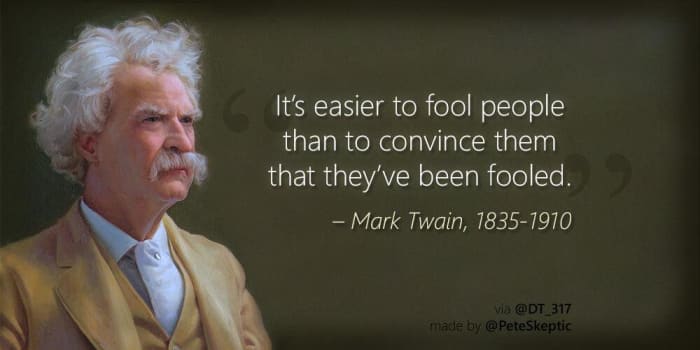
And here’s some history leading up to how we’ve been fooled and continue to be fooled every day…
Matt DB HarperJan 25, 2018
There once was an old German education professor who also happened to be a magician. He would sometimes entertain drifting students with an unexpected magic trick during class, like pulling a coin from a sleepy student’s ear. If a student happened to compliment him on his ability, he’d mumble, “Keine Hexerei, nur Behändigskraft.” Which means: “No magic, just craftsmanship.” The craft he spoke of entails engaging the viewer in a visceral way to create a new reality (a “perceived” reality that is, by no coincidence, in harmony with the intent of the director,) and this “created/fantasy” reality then promotes a stronger emotional bond to the subject by diluting any detachment the viewer may have had previously. Much like the master illusionist, the propagandist works in the same way, swaying and influencing public opinion by means of creating a disassociation between public opinion and personal opinion. In so doing he utilizes the natural confusion that results from humanity’s need to translate their beliefs into reality and creates or manipulates a supposed desire for action. Simply put, propaganda tells you an idea is true, and then reinforces its assertion by fooling you into believing you came to the conclusion independently – or even better, that you had held the belief all along.
Interestingly, not long before the popularization of propaganda, German psychologist Sigmund Freud pioneered the study of human will in correlation with the conscious and unconscious being. He proposed that man did not in fact enjoy the luxury of free will, but rather was a slave to his own unconscious; that is to say all of man’s decisions are governed by hidden mental processes of which we are unaware and over which we have no control. Most of us largely overestimate the amount of psychological freedom we think we have, and it is that factor that makes us vulnerable to propaganda. Drawing directly from the studies of Freud, the psychologist Biddle demonstrated that “an individual subjected to propaganda behaves as though his reactions depended on his own decisions…even when yielding to suggestion, he decides ‘for himself’ and thinks himself free—in fact he is more subjected to propaganda the freer he thinks he is.”
The successful use of propaganda depends on the creator generating some emotional response in the viewer. If the subject is political, for example, then fear (the most popular), moral outrage, patriotism, ethno-centrism, and/or sympathy are typical responses that the propagandist might try to elicit. This is done by attacking the surface consciousness of the masses and creating a disassociation between public opinion and the propagandee’s personal opinion. In doing so, the individual will work out “justifications and decisions for behavior which will conform to social demands in such a way as to make him least aware” of his guilty conscience.
The notion of propaganda is one whose origin could probably be traced back to the dawn of man. If the people of a tribe were in need of food they would come together around the fire, call to the hunter, inform him as to the necessity of food from the next hunt, and the hunter would be forced (by both responsibility and his conscience) to go out the next day and do his best to bring back food for the tribe. Here we can imagine the first sign of man acting regardless of his own desires in the name of societal betterment. Surely he is not the only one capable of finding and delivering food, yet he has accepted this role and does it to the best of his abilities when called upon to do so simply because it is so.
Conversely, the word “Propaganda” is a relatively new term and is most often associated with ideological struggles in the twentieth century. The American Heritage Dictionary delivers a relatively simplistic definition of propaganda as the systematic propagation…of information reflecting the views and interests of those advocating such a doctrine or cause. In other words, assertions given by those who support them.

The first documented use of the word ‘propaganda’ was in 1622, when Pope Gregory XV attempted to increase church membership by strengthening belief (Pratkanis & Aronson, 1992). Whether for the betterment of the congregation or the institution, Pope Gregory XV sought to directly influence theological “belief”. The relevance of this event lies in the fact that the focus of modern propaganda, as we speak of it, is a manipulation of belief. Beliefs, those things known or believed to be true, were realized even in the seventeenth century to be important foundations for both attitudes and behavior and therefore the essential target of modification.
In Europe propaganda was quite impartial during the eighteenth and nineteenth centuries describing various political beliefs, religious evangelism and commercial advertising. Across the Atlantic, however, propaganda sparked the creation of a nation with Thomas Jefferson’s writing of the Declaration of Independence. The popularity of literary propaganda had spanned the globe and the medium was made famous in the writings of Luther, Swift, Voltaire, Marx, and many others. For the most part, propaganda’s ultimate goal throughout this time was the increased awareness of what their author’s genuinely believed to be truth. It was not until the First World War that the “truth” focus was reconsidered. Around the world, advances in warfare technology, and the sheer scale of the battles being fought, made traditional methods of recruiting soldiers no longer sufficient. Accordingly, newspapers, posters and the cinema, the various media of mass communication, were used on a daily basis to address the public with calls to action and inspirational anecdotes – with no mention of lost battles, economic costs, or death tolls. As a result, propaganda became associated with censorship and misinformation as it became less of a mode of communication between a country and its people, but a weapon for psychological warfare against the enemy.

The tremendous importance of propaganda was soon realized and the United States organized the Committee on Public Information, an official propaganda agency, whose goal was to raise public support of the war. With the rise of mass media, it soon became apparent to the elite that film would prove to be one of the most important methods of persuasion. The Germans regarded it as the very first and most vital weapon in political management and military achievement (Grierson, CP). By World War II, propaganda was adopted by most countries – except those democratic countries who avoided the negative connotation the term, and instead cleverly distributed information through the guise of “information services” or “public education.” Even in the US today, the methods of providing and the learning of knowledge are deemed “education” if we believe and agree with those propagating the information, and considered “propaganda” if we do not. Not coincidently, central to both education and propaganda are the roles of the fact, the statistic, and that which the target believes to be true.
Propaganda’s modern connotation is that of mass persuasion attempts to domineer established beliefs. However, great thinkers and theorists have been studying persuasion as an art for most of human history. In fact the persuasion of a viewing party has been an important discussion in human history ever since Aristotle outlined his principles of persuasion in Rhetoric. With the birth of modern technology and the development of film, propaganda became a significant and perhaps the most highly effective form of persuasion through the utilization of one-way media. As early as 1920, a scientist named Lippman proposed that the media would control public opinion by focusing attention on selected issues while ignoring others. And it is no secret that the vast majority of people obediently think as they are told. It’s just human nature–who has the time or the energy to sort out all the issues one’s self? The media does this for us. Censorship and one way media protect the few from extraneous or divertive impulses that might lead him to examine the new reality in a way that doesn’t harmonize with the director’s intent. It offers us safe, often comforting opinions that appear to be the consensus of the nation. It appeals to the masses “through the manipulation of symbols and of our most basic human emotions” to achieve its goal – that of the viewer’s compliance.
Compliance is an easy and immediate solution to a social problem. Compliance does not require the target to agree with the campaign, just simply perform the behavior. Such an accomplishment was not easily attained, and it took some of the greatest, and most vicious, minds of our time to do so effectively.
Propaganda adheres wholeheartedly to the moral that the supreme good is the confusion and defeat of the enemy. The propagandist must have a full understanding the words and images that portray his message and a method to deliver the combination in a way to implant the message with out divulging that it is doing so. John Grierson argues that free men are relatively slow on the uptake in the first days of crisis…(and) your individual trained in a liberal regime demands automatically to be persuaded to his sacrifice…he demands as of right—of human right—that he come in only of his own free will. Great propagandists are successful because they have a great understanding of how to reach the heart of the masses. To borrow an example from Dr. Kelton Rhoads, they went beyond simplistic thinking like, “What can we say to make people decide to buy a car?” but rather, “What makes people decide to say yes to all sorts of requests–to buy a car, to contribute to a cause, to take a new job?”
One person who had full knowledge and took full advantage of man’s inherent vulnerability was Adolf Hitler. Considered the greatest master of scientific propaganda in our time by John Grierson, Hitler said outright, ‘…the infantry in trench warfare will in future be taken by propaganda…mental confusion, contradiction of feeling, indecisiveness, panic; these are our weapons.’ Sun Tzu said, to subdue the enemy without fighting is the highest skill. Hitler had such a skill, and by utilizing his “weapons” Hitler was able to predict and cause the fall of France in 1934, as well as strike fear in the eyes of outside nations while rousing the hearts and courage of a rising army within.

Propaganda relies heavily on different tactics of persuasion to manufacture a specific belief in the mind of the viewer. Depending on who you ask there ranges anywhere from two to over ninety tactics that exist on many levels and degrees of intensity. To be effective, propaganda has to make a complex idea simple as its success is based on the manipulation and repetition of these ideas. In looking directly at Hitler’s use of propaganda film we will put our focus towards its reliance on confusion of fantasy and reality through the style of realism and extratextual conditions.
The most notorious of the Nazi “fantasy/reality” films is called “The Eternal Jew.” Under the insistence of Joseph Goebbles, this film was assigned to and produced by Fritz Hippler as an anti-Semitic “documentary”. Characteristic of Hippler, this film, often called the “all-time hate film”, relied heavily on narration in which anti-Semitic rants coupled with a selective showing of images including pornography, swarms of rodents, and slaughterhouse scenes that alleged to display Jewish rituals. His footage showed masses of the hundreds of thousands of Jews that were herded into the ghetto, starving, unshaven, bartering their last possessions for a scrap of food and described the horrific scene as Jews “in their natural state.” He showed rats scurrying in droves from the sewers and leaping at the camera while the narrator comments on the spreading of the Jews “like a disease” throughout Europe: “Wherever rats turn up, they spread annihilation throughout the land… Just like the Jews among mankind, rats represent the very essence of malicious and subterranean destruction.” Hippler dutifully provides before and after photos of Jews attempting to hide their true selves behind a façade of civilization allowing German audiences to recognize them for who they truly are and not be fooled by there cheating, filthy, parasitic species. The audience is then provided a supposed history on the Jew and his deceptive ways. This is done so by showing “documented” scenes from the fiction film The House of Rothschild. We see a rich Rothschild, played by George Arliss, hiding food and changing into ratty old clothing to deceive and cheat the tax collector, and are expected to accept it as fact rather than a Hollywood production. The film goes so far as to single out Albert Einstein (at this time already quite famous) by showing his picture with the commentary: “The relativity-Jew Einstein, who concealed his hatred of Germany behind an obscure pseudo-science.” Though seeming absurd today, the film acted then to incite an anxiety and confusion in the German people at the threat of a thriving disease-ridden people, and seemingly no solution for the problem. The climax of the film is a powerfully disturbing warning and declaration of hate by Hitler himself assuring the people that there is no problem. Taken from a speech to the Reichstag in 1939 it translates as:
If the international finance-Jewry inside and outside Europe should succeed in plunging the nations into a world war yet again, then the outcome will not be the victory of Jewry, but rather the annihilation of the Jewish race in Europe!
Closure comes in the foreboding words of Hitler as he adamantly proclaims that all of these troubles will soon be taken care of.
Although this passing off of fiction footage as documented truth is today simply embarrassing and completely counter-effective, it was not an entirely new concept at the time. In reality, the method of sampling footage from other films to enhance your own was becoming quite common. In America, for instance, it was feared by officials that anti-war and anti-foreign entanglement feelings prevailed between the wars, and in general the ordinary American didn’t give “a tinker’s dam” about Hitler (Rowen, 2002). The Army had actually been producing hundreds of training films but Chief of Staff George C. Marshall was looking for something different. He mapped out objectives and hired Hollywood director Frank Capra to carry out his proposed Why We Fight film series, essentially to justify fighting in such a long and costly war. But along with the arduous task of completing Marshall’s 6 objective plan, Capra undertook perhaps the one most basic and fundamental objective that a film used in troop information sessions had: holding the audience’s attention. As such, it was necessary to have footage that was not only exciting but displayed a positive outlook on the war for “our boys,” no matter the source. This is a major reason why “The Nazis Strike” and the Why We Fight series in general are probably best described as compilation films rather than documentary and therefore very much a job of effective editing. Set on the objective of boosting moral, Capra hired Hollywood actor Walter Huston as a narrator, commissioned Disney to produce maps and animation through an agreement with the government, and cut between footage from US Federal programs and, a propaganda masterpiece, Leni Reifenstahl’s Triumph of the Will to keep a fast paced and interesting series of films.
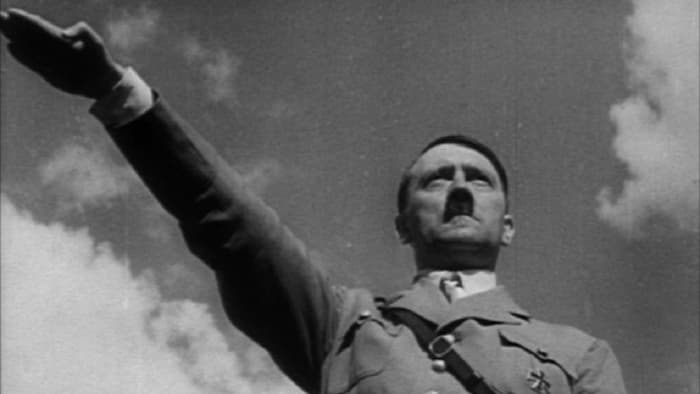
Upon its release in 1935, Leni Reifenstahl’s Triumph of the Will, a documentary of the sixth Nazi Party Congress at Nuremberg, displayed beyond doubt the power of propaganda film. Hitler’s descent from the sky in a shiny silver airplane presents him as a deity on the helm of technological achievement. Always looking down upon the people he so cares for, his demeanor is always pleasant. In fact the only time he gets riled up is for a speech, and then we get see just how energetic and passionate he can be when it comes to achieving the best for his country and its people. Through an extraordinary choreography of images and sounds, from marching men, swastikas, cheering women and children, and folksongs, the film inspired some, terrified others, and ultimately rallied many to the Hitler cause. No film was more widely used by opposing forces to vividly display the wicked nature of its enemy than Triumph of the Will. Striking a blow against the opposition by provoking fear while at the same time calling to arms the loyalty of thousands upon thousands, this tremendous outpour of emotion and action as a result of masterful imagery and film editing is the epitome of what propaganda stands for.
German audiences reacted to The Eternal Jew with cheers at the suggestion of the annihilation of the Jewish race in the film. Reminiscent of Cicero and his renowned ability in ancient Rome to demonstrate murdering villains as laudable patriots and have them subsequently acquitted, Hipple presents Hitler, (apparently) convincingly to Germans, as a hero rather than a eradicator for his plans to extinguish an entire race of people. Reifenstahl edits in the sounds of roaring crowds at the conclusion of the descent of Hitler in his flying machine from the heavens above. In Triumph of the Will, the Fuhrer was a gentle simple soul, serving his people, humble in his triumphs. Capra, in turn, used the tools of Hollywood to glamorize and rally up our troops in support of a war that was killing thousands and costing millions. What we come to realize is that very little importance is given to whether or not propaganda is true, but rather it is whether or not it gets someone to act. In these cases they did exactly that.
Conversely, with the rising popularity of injecting the masses with beliefs, there came another movement in direct opposition: film which sought to control the sub-consciousness of a people. Leading the way was surrealist Luis Bunuel with his stunning satireLand Without Bread. Bunuel took a village of average people from the mountains of Spain and created a sad, decrepit world full of misery and death simply to mess with your head. The statement he was making was in fact quite bold and executed so well that it made you seriously question your susceptibility to deception. His portrayal of tragic scenes of an unlucky goat, and, you are told, starving children who have to stay at school to eat their bread for fear of it being stolen by their greedy parents, accompanied by a soundtrack of heroic and upbeat music works effectively to pry apart your acceptance of what is real and question what it is you are watching.
In a complete opposite method, John Huston’s Battle of San Pietro seeks to dispel our skepticism in the legitimacy of film by divulging as much information in the most descriptive details possible as to leave no question of its sincerity. This abundance of information acts to put you in the place of a real soldier as you follow, side by side with the infantry, watching the action, even experiencing the death of fellow soldiers as we see the life extinguished of two people, both from in front and behind the camera. Its chilling realism sought to let you have the whole experience on your own rather than edit out the bad parts.
Alain Resnais’ Night and Fog served two purposes. That of a vigorous indictment, and that of a lesson for those to come. He frequently shifts back and forth from warm colored, serene images of the former extermination camps to horrific black and white images of the carnage they produced. In a time when documentarists were in no way being subtle about the films they made, Resnais used his film to take a calm and composed look back at the horrific incidences that took place and at the death camps and establish a need, not for acceptance, but for remembrance. He used film in a shockingly beautiful and gruesome way to express the importance of not forgetting those that were lost.
There is an insidious psychological process called the “Self-serving Bias.” This bias leads us to believe that we are immune to the influences that affect the rest of humanity. And it is that belief that these three film makers were directly aiming at exploiting. They rely more on an empathetic identification than anything else. By eliciting a strong emotional response from the viewer, the viewer is persuaded to believe his feelings take precedence over an authoritative or legislated principle or rule. For example, modern Christianity tends to see the Ten Commandments as mood oriented suggestions rather than moral absolutes. If our feelings are strong enough, then God will grant dispensation. “It just seemed to be so right for me”…..denies authority to “thou shalt not commit adultery” for example.
Dr. Kelton Rhoades delivers the example to television watchers old enough to remember the Kung Fu television program. “Whose side were you on when the prejudiced, muscle-bound drunk lunged at peace-loving David Carradine with a broken beer bottle? Did you enjoy watching Carradine turn the enraged belligerent’s charge into a devastating floor-slam? The point is that these films invoke a sense of emotion that suddenly makes us realize a truth only when we look within ourselves and acknowledge that the so-called “greater good” is not always the greatest good; and often it’s not good at all.
The word “propaganda” is often invoked when it is obvious that objectivity in a film has ceased. The irony is that the term is invoked precisely when the film has failed as propaganda. When the choices please us, we do not mention it. In a sense, all film makers are propagandists as they try to create a mood for the viewer and invoke feelings to draw you into the story. Yet in all fiction, the viewer must maintain a willingness of disbelief. It is not a healthy mind that can watch the Terminator films and not realize that what they are seeing is fiction, no matter how realistic it looks and sounds. “Documentary” and “propaganda” on the other hand, and this is why they can be such manipulative tools, use supposed images of reality to create a story and therefore is seen by the viewer as not requiring that willingness of disbelief. You don’t have to constantly remind yourself that it isn’t real, because it is in fact, in one way or another, “real”, and that is enough to make you believe. As long as you think yourself insusceptible, there will be someone just above you pulling on a string; there will be someone there to pull a coin from behind your ear when you are not doing what you are supposed to.
Bibiliography
Barnouw, Erik (1993) Documentary : a history of the non-fiction film. Oxford: New York
Delwiche, Aaron (1995) Wartime Propaganda: World War I: The Drift Towards War http://carmen.artsci.washington.edu/propaganda/war1.htm
Ellal, Jaques. The Psichic Dissassociation Effect of Propaganda . CP pg. 31-33
Grierson, John . The Nature of Propaganda . CP , pg. 13-19
Hornshoj-Moller, Stig. (1998) On ‘The Eternal Jew’ http://www.holocaust-history.org/der-ewige-jude/
Hornshøj-Møller, Stig, (1997) Paper presented at the conference “Genocide and the Modern World,” Montreal, Canada
Pratkanis, A. & Aronson, E. (1992). Age of Propaganda. Freedman: New York.
Rhoads, Kelton Ph.D. “Introduction to Influence” www.workingpsychology.com , 1997/2002
Wistrich, Robert S. (1996) Weekend in Munich: Art, Propaganda and Terror in the Third
Reich. Trafalgar Square
© 2017 Matt DB Harper